--------------------------------
‘Alchimis(t/r/ick)-machines
At the ‘Alchimis(t/r/ick)[1] college there are some machines, some desirable machines, that love to pretend to do more than they really do.
In a pursuit of ‘pataphysics – the science of imaginary solutions – they never reveal their inner nature, their origins and illusions, genuineness and fakeness. Simultaneously speculative, fictional and accurately and efficiently productive, they navigate in the world of Yestertomorrowday, happily and innocently, walking briskly over the mountain of 20th-century rubbish. Using strange apparatuses, these ‘Alchimis(t/r/ick) machines symmetrically articulate different arrows of time and layers of knowledge, but more specifically they negotiate the endless limit of their own absurdity, where behavior that seems illogical is protocolized by an extreme logic of emerging design and geometry, where input and output are described by rules and protocols…
Neither a satire of the worlds, a techno-pessimism nor a techno-derision, they are located at the limit – or constitute the limit – between the territory of conventions, certainties and stabilities where one can comfortably consider everything legitimated by an order, or an intuition of an order, and all other territories, whether produced by paranoia or fantasy or reported back by travelers…
In a casual and basic sense, machines have always been associated with technicism and used as the extension of the hand, through its replacement or improvement by accelerating its speed and power to produce and transform. But it seems very naïve to reduce machines to this first, obvious layer of their objective dimensions, in a purely functional and "machinism" approach, exclusively limited to Cartesian productive power, located in the visible spectrum of appearance and facts. Because machines also simultaneously produce artifacts, assemblages, multiplicity and desires and infiltrate the "raison d’être" of our own body and mind in the relationship to our own biotopes[2]. Basically everywhere in nature, they are at the origin of all processes of exchange, transactions of substances, entropy and vitalism[3]. Machines are a paradigm for the body in the sense of its co-extensibility with nature, through processes, protocols, apparatuses, where transitory and transactional substances[4]constitute and affect simultaneously all species, their identities, their "objectivized and subjectivized" productions and their mutual relationships…
In this pursuit of a polyphonic approach, we cannot overlook the concept of the "bachelor machine"[5] as an attempt to integrate "machinism" apparatuses into a narrative of transaction and transmutation (in the alchemical sense). Contradictorily, these ‘Alchimis(t/r/ick)-machines operate as direct critique and denunciation of capitalist managerial reductionism, which replaced uniqueness and rarity with a system of repetition and standardization, erasing both the workers (when they are not becoming machines themselves[6]) and any singularities, any anomalies… providing products for a strategy of servitude which combined mass production and the production of the alienation of mass, as described by Walter Benjamin[7]. In opposition to this predictable ONE WAY dependency, bachelor machines simultaneously convey the fascination of this sophisticated human construction, its eroticism, its barbarian eroticism[8], the "impulsion" and repulsion it generates, as a permanent schizophrenia alternating between its simultaneous potential for production and for destruction[9], for a permanent dispute between Eros and Tanatos. They are vectors of both resistance and production, infiltrating the arrogance of the mainstream and revealing its schizoid values… The same industrial system produces both outcomes; their geneses are consubstantial, and their diametrically opposed collateral effects depend mainly on our ability to see and make visible that which lies beyond the mirror.
In the work of R&Sie(n), ‘Alchimis(t/r/ick) machines try to reveal these disturbances, or are constitutive of them. The blurriness between what they are supposed to do, as perfect alienated and domesticated creatures, and the anthropomorphic psychology we intentionally project on them, creates a spectrum of potentiality, both interpretative and productive, which is able to re-"scenarize’’ the operating processes. A mind machine simultaneously transforms the real and our perception of what we consider real. In this sense machines seem to be vectors of narratives, generators of rumors, and at the same time directly operational, with an accurate productive efficiency. These multiple disorders, this kind of schizophrenia, could be considered a tool for reopening processes and subjectivities, for re-"protocolizing’’ indeterminacy and uncertainties. Agents of blur logic, of reactive and reprogrammable logic, the scenario created by and through these "machinism" processes asymptotically touch their own limits, revealing the fragile and movable border line between what seems to be, what should be and what should have been. The creatures produced by this machinism confront exterior forces, their ambivalence, their contingencies, their instability… They allow us to "exercise our power, to be conscious of our power, the consciousness of our power that is by the same token self-consciousness, consciousness of our vulnerability in the face of the enormity of this power[10]."
They cross the line of logic and walk in the fields of absurdity as an intentional value!
- For us and some others / absurdity is a strategy to expand the territory of "what could be," and simultaneously unbolt the locks on our mind and perception… and production…
- For all others / absurdity is a strategy to qualify the limit of "what could not be" and disqualify everything outside of the territory they previously defined.
Genetically Siamese and consubstantial, it appears as a dysfunctional reflection in the mirror, organizing the way "we and the others" frame conflicts arising precisely from the state of the mirror, to quote Lacan[11]/ Where the perception of the unicity of our corporality, through the mirror, is constructed in coincidence with the defragmentation of the perception of our environment. The process of "reductionism" to One Body is the symmetrical reflection of the One World, where all the complexities, the schizoid and paranoid assemblages, early childhood’s sweet disruption of consistency, are trapped in a univocal representation, framed and simplified. And consequently all the alien fragments that cannot fit in this perfect and comfortable representation of "INselves and OUTselves" are considered fatally flawed by absurdity, weirdness and oddity in order to preserve the illusion of this symmetrically operative but vain unicity. Beyond this point in childhood, we can never again experience the taste of "cul-bite-bouche-poil-chatte[12]", with this multiplicity of distance and territories (where animalism, animism, acephalous bodies (CsO) and consciousness are interweaved with guilt-free discovery…
"Let me see: four times five is twelve, and four times six is thirteen, and four times seven is –oh dear! I shall never get to twenty at that rate!" said Alice in the "The Pool of Tears," but what appears odd is just a multiplication exercise using different bases and positional numeral systems… The confusion created by Charles Dodgson[13] arises contradictorily from a mathematic construction, not from triviality or irony, and still less Alice’s childishness. The disqualification we carry out is a strategy to avoid seeing that which cannot be, "ce qui n’a pas de raison d’être," that which goes beyond our possible understanding and creates a "malentendu[14]" between our vision of the world as we have we simplified it (state of the mirror syndrome) and the contradictory complexity and "non sens" it generates as a permanent shadow theatre.
Like Alice in Wonderland, we have to confuse our little girl’s perception with such apparatuses of "misunderstanding", stretching lines of subjectivization to organize the physical perception of our paranoia. Absurd protocols seem simultaneously markers and activators able to de-alienate the edges of the illusory "truth" system, in order to re-invert the logic of meaning and turn it into a multiple vanishing point… As we suppose the mirror is simultaneously a landscape with a double Janus face, a simple glass over a brick wall, a mathematic and geometric construction to extend light rays through the surface to trace the discovery of an optical logic, or… the door to some parallel universe[15]' sometimes simulated to symmetrically reproduce our own environment…
Who said in the audience that we have to choose one? Who said that? I have to know…
The history of science was an ideal playground for this multiple disorder pathology… confronted by the denial and disqualification of "that which cannot be," sometimes out of ignorance but mainly because of reductionist conviction. The ideological dispute about the theory of heliocentrism[16] could be one of the best paradigms for the fragile boundary between official logic and infringement illogic, as the substrate, the loam for the absurd substances that sprouted until they finally reframed the frontiers of our knowledge… by metabolizing what was previously considered toxic to our framed and "bourgeois"[17] equilibrium.
‘Alchimis(t/r/ick) machines seek to articulate things and minds, objective and narrative production, "machinism" causalities and unpredictable dependences, to interrogate their "raison d’être "and the eroticism of their transgression, weaving together the malentendus and the illusions they generate, in a different arrow of time:
"Here and now" as a live transaction, "here and tomorrow" as an operative fictional scenario, "Elsewhere and simultaneously" for
speculative and political research... navigating between apparatuses of "animism, vitalism and mechanism".The tools of mechanization drift from a self-organized urbanism (an "architecture des humeurs")[18] to a stochastic machine with a predictable completion (Olzweg)[19] from the "machinism" ghost of a wild DMZ forest (heshotmedown)[20] to a paranoiac uranium laboratory (TbWnD)[22] to a simple transportation machine, a stargate experiment(Broomwitch)[23]
.Their ‘alchimis(trick) and skyzoid agendas are both products and vectors of paranoia[24]
.---------------------------------------------
Footnotes
[1] A reference to the Collège de 'pataphysique founded in 1948 in honor of Alfred Jarry. We could consider the OuLiPo (Ouvroir de littérature potentielle, Workshop of Potential Literature, whose members included the mathematician François Le Lionnais and Raymond Queneau) the first branch of that group, and the ‘Alchimis(trick) as a rotten branch of that branch. [2] A reference to the work of Ilya Prigogine, who considered human beings a "mechanism" of exchanges, of shared substances IN and OUT and vice versa. [3] "Vitalism presumes a monadological rather than atomistic ontology. In Leibniz’s ‘monadaology’ all substances are different from one another, whereas its opposite, Cartesian ‘atomism,’ presumes that matter is comprised of identical parts (atoms)." Scott Lash. [4] "All bodily phenomena can be explained mechanically or by the corpuscular philosophy." Leibniz, Letters to Arnauld. [5] Developed by a multitudes of artists, philosophers and writers such as Duchamp, Poe, Kafka, Deleuze and even, subconsciously, Cervantes. The term "bachelor machine" was first used by Marcel Duchamp around 1913 in connection with pieces of work that would later be assembled in the Large Glass of 1915-1923. For Deleuze and Guattari, the "bachelor machine" forms a knot between desirable machine and the body without, to create a new myth which seems to articulate Narcissus, Opheus and Sisiphus. It has been isolated by Michel Carrouges (in his book Machines ceìlibataires / Arcanes, 1954) [6] As seen in the organization of Henry Ford’s Detroit factories (Fordism). [7] Walter Benjamin, "The Work of Art in the Age of Mechanical Reproduction," 1936. [8] From Poe’s "The Pit and the Pendulum" and Kafka’s "In the Penal Colony" to Ballard’s Crash. [9] The latest subculture icon: Avatar, where the metempsychosis machine saves the ecologically-balanced Ewya Kingdom from the caterpillar machine which destroys the blue hobbits’ dreamtimes. The both are coming from the same "tea pot". [10] Recorded lecture by Gilles Deleuze at the University of Paris-Vincennes in 1980. The exercise of our power as Nietzsche and Deleuze understood it, as a gift, a creation, and not the kind of dominance that they (the machines) could grant us. [11] Le stade du miroir. Théorie d'un moment structurant et génétique de la constitution de la réalité, conçu en relation avec l'expérience et la doctrine psychanalytique 1937. [12] "Ass-Dick-Hair-Mouth-Pussy" as the nearest reachable, fragmented environment. [13] The mathematician Charles Dodgson wrote under the name Lewis Carroll. [14] A malentendu is something between mishearing and misunderstanding. [15] In physics, quantum mechanics: Universes separated from each other by a single quantum event. [16] From Ptolemy to Hipatia of Alexandria, Copernicus, Galileo and Kepler to Einstein. [17] In the Marxist sense, the social class that owned the means of production in the 19th century and now owns, through the media, culture, the means of manipulating desires and subjectivities (Antonio Negri). [18] An "Architecture des Humeurs" / 2010. [19] Olzweg / 2006. [20] Heshotmedown / 2009. [21] The Building which never dies / 2009 -10. [22] Broomwitch / 2008. [23] In both senses, "critical paranoia" and pathological paranoia. Used before by R&Sie(n) in the book BIO[re]BO[o]T------------------------
Five apparatuses
------------------------
Five apparatuses
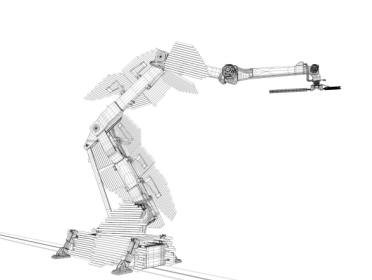
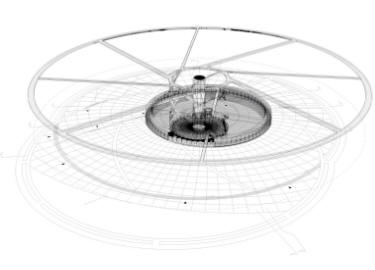
Olzweg: A stochastic machine that vitrifies the city, starting from a museum of architecture as the origin of the transformation, of the contamination, in the pursuit of Frederick Kiesler (endlessness) and more surprisingly Le Corbusier ("le musée spirale à croissance illimité"). This smearing is done by pollution, through the recycling element of glass from the French wine bottle, swallowed and vomited through a process of staggering, scattering and stacking, by the machine to become the visible part of the consummation of substances in search of parallel universes to escape our own servitude. The random aggregation is a part of this unpredictable transformation, as in Kafka’s "Metamorphosis." We know when it starts but cannot predict its outcome, as a fuzzy logic of the vanishing point. The machine works to extend a museum and acquire "voluntary prisoners" rapped in the permanent entropy of the graft. The opposite of an architecture that petrifies, historicizes, panopticalize, classifies and freeze-dries in the maze of its multiple trajectories
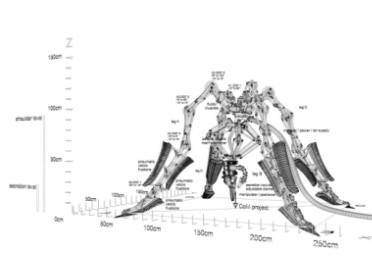
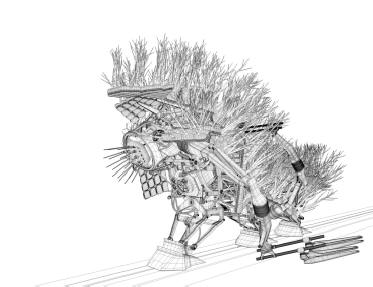
Heshootmedown: A tracked biomass machine to penetrate into the DMZ, the demilitarized zone between North and South Korea, collect the rotten substances, the superficial coating of the forest in decomposition, and bring back this material to plug all the external surfaces of the building, in this way creating, through the fermentation of the grass and the heat its chemistry produces, a natural eco-insulation. Full of land mines, the DMZ is a joint security area, a restricted zone, where North and South play Cold War. The heshootmedown machine collects the pathological ingredients of this period and recycles them for productive use. This no-man’s land has been abandoned since the end of the war more than half a century ago. In this re-appropriation of nature by nature, elves, wizards, witches and harpies come back, new species appear, and legends and fairy tales are transported back to the safe zone, the south zone, as in a "Stalker" experiment.
A paranoiac machine / TbWnD: An alert machine or a marker of our past/future. A laboratory of dark adaptation and the detection of the intensity of solar radiation by the afterglow on external surfaces, the influence of the sun’s seasonal and daily emissions on surfaces directly "touched" by its rays. The phosphorescent components ("Isobiot®opic" oxide pigment made from raw uranium) work as a UV sensor and detector and indicate by night the intensity of the UV rays that shone on the area by day, including on humans and all other species. Thus the oriented glass components in this Sunflower laboratory reveal and make visible the dangerousness of the sun’s radiation and the changing ozone concentration in the stratosphere. This machine articulates the dangerousness of nature and the science developed by the exploration of the nature in the past (from Marie Curie to Little BOY), and at the same time this Isobiot®opic element becomes a marker of the uncertainties of our future due to the after-effects of human scientific development.
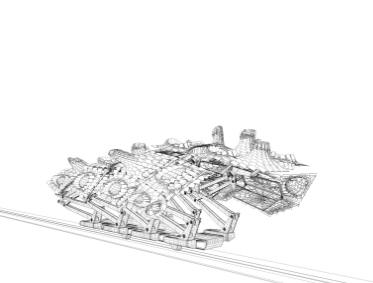
A transportation machine / broomwitch: A transportation machine from sitting down to standing up as a shortcut of human evolution, from the André Bloc house to this ghostly monstrous excrescence in the back of the garden as its heterotopical extension. Like a time machine, a machine to travel from the illusion of happiness of panoptical buildings and values of the 1950s to their consequences – the warming biotope, nature’s revenge. This element allows us to consider the direct link between these two realities... as an history of this crime.
Beam me up, Scotty!A machine of the « multitudes » / an "architecture des humeurs": A utopian machine to produce a self-organized urbanism conditioned by a bottom-up system in which the multitudes (in Spinoza and Antonio Negri’s use of the word) are able to drive the entropy of their own system of construction, their own system of vivre ensemble. This architecture des humeurs is based on the potential offered by contemporary science to reread human corporalities in terms of their physiology and chemical balance. It uses technology to make palpable and perceptible the emotional transactions of the "animal body," the headless body, the body’s chemistry, so that it informs us about individuals’ adaptation, their sympathy and empathy, when confronted with a particular situation and environment, and adapts this result to an endless process of construction through "machinism" behavior. The development of a secretion and weaving machine that can generate a vertical structure by means of extrusion and sintering (full-size 3D printing) using a hybrid raw material (a bio-plastic-cement) that chemically agglomerates to physically constitute the computational trajectories. This structural calligraphy works like a machinism stereotomy comprised of successive geometrics according to a strategy of permanent and repetitive anomalies.
_________________________________________________
30 mn lecture / Engineered Transparency Glass / In Architecture & Structural Engineering / Session 2 / Tape B / COLUMBIA GSAPP
-----------
In the shadows of the mirror
...I refused to look at myself in the mirror, to use Lacan’s metaphor, and in this way I reject the possibility of re-assembling the multiple fragments, the multiple disorders I have to re-articulate. The glass is definitively broken, and there’s no previously existing picture of this reflecting puzzle with which to reconstruct it. What’s worse, the picture is still here, on the floor in a multitude of images themselves in a multiples fragments, disseminated as an Opus Incertum. In this sense, the glass remains at a fractal level, instead of reducing the existence of the unknown by limiting it to its own appearance, by the reflective reduction of the reassembled reality.
We could accept this non self-representation as the first lost effect of the broken glass.
Glass is both a substance and an ideology, it’s an apparatus that can be pulled and pushed in any direction. It helps us move from the mythology of transparencies and technologies described by Rolland Barthes, with its positive overvaluing, to other strange boundaries, more ghostly, with blur refraction and lead anomalies altering perception, like an illusionist membrane…
To circle the topic without touching it, I would like to describe, in chronological order, four protocols used in R&Sie(n) projects, an iconic one for Shadows & Light (links), a dynamic protocol for Unplug (links), one involving elimination for Spidernethewoods (links) and, to end the session, the recycling “bachelor apparatus’’ for Olzweg (links).
First protocol: Shadows & Light. Here we have tried to articulate technologies and profane emergences, dealing with and negotiating positive and hygienic values and the forest of the unknown. This project for the Japanese Cultural Center in Paris is schizophrenic. It dates back to 15 years ago, when I was interesting in using the glass box as just as it claims to be, a glass box. We proposed an opposition of two atmospheres, two climates, one the modernistic cultural myth from Jacques Tati’s Playtime, the other by some wild, evil genius, something between Blair Witch Project and Fitzcarraldo.
The theme of this project was the use of glass as a metaphor for a dry climate, an over-domesticated, cold and inert biotope, a psycho-interpretation of the materiality produced in a standard flat panel, the illusion of transparency – a phantasm of accuracy and sophistication, of an enlightened century, of panoptical space in Michel Foucault’s sense, with its ideology of surveillance, contrasted with a toxic mushroom mountain, a Sturm und Drang heterotopic cavern, with its humidity and echoing sounds, a place where Mephisto, hidden in the darkness, is dealing with the boundaries of human nature. In that period of our work this schizoid articulation was very literal, in a way, perhaps too closely following Guattari and Deleuze’s strategy of schizoanalytic cartography. But it was a kind of starting point, the birth of the R&Sie(n) studio. Later, after that initial period, we found a way to go further – by more fully striving to achieve an incestuous union and hybridization between the dream of Galilean technology underlying the field of architecture, with its ideological hoax, and the recognition of the failure of that dream, like a “morning after” feeling. Re-reading Mikhail Bakhtin’s re-reading of Rabelais, the French author of Pantagruel and Gargantua, helped us to include within each idea and project a resistance to the values developed by the project itself. The grotesque quality, the profanation, the freakishness – all these are vectors of radical criticism, a blur mirror, a negotiation with Bataille’s “la part maudite,” an articulation between the propaganda of technologies and distrust in it.
The material so perfectly embodies the metaphorical costume of ideology of progress that it becomes an ideal tool to give back the gift, unalienating, in this way, the relationship between causalities and dependencies.
The Unplug project is the second protocol articulating this ambiguity. It is a project commissioned by France’s national electricity company, EDF, for the design and construction of a fully unplugged – off the grid – tower in La Defense, a business district just west of Paris. The point was to design a structure that defined and provided its own resources using solar energy. This commission directly involved us in the field of sustainable development, renewable energy, and its collateral effect on moral consciousness. At that time EDF was committed to developing a department dedicated to concept buildings, in the same sense as automobile companies make concept cars. The objective of this kind of industrial design object is to be a vector of both research and feedback, a way to measure the demand created by the product itself. Prototype buildings were to come at the end of the process, after a period of testing, to develop market projections for sustainable development technologies, the selling of products, services and knowledge. This unplugged tower explored the solar energy potential of the glass façade and all the steps entailed, from research, applications and production to retail sales. The protocol we developed sought to articulate this ambiguity between producing goods and providing services, where the item-device is directly territorialized within the building matrix and becomes an osmotic extension directly embedded in the flesh of the building, a Siamese generative mutation. To carry out this strategy, we started by approaching solar power research from two different angles, first photovoltaic cells with left curved surfaces to supply electricity, and secondly glass tubes without atmosphere with liquid silicone and glycol for the heating system.
These elements could be compared to a living graft, where glass protuberances and hair are plugged into the network, in direct relationship with the electrical nervous system and the warming blood of the building itself. We had to consider this solar element as intrinsically an “elephant man’’ mutation of the glass skin, and to design it as a collateral effect of transformation.
With this healthy profanation of the purity of the glass facade, we tried again to unalienate the residual positivism of these technologies, to interrogate the nature of their lost, deterritorialized identity, the shift from a positive degenerative cancer to anomalies and mushroom-like (or tree-like) protuberances for symbiotic exchange. One device, with its hairy surface, looked like fur, and the other, with its glass excrescences, seemed to be a disease of the flat panels. Beyond this unshaved and diseased appearance, what we were talking about was the transsexuality of a typical downtown skyline when this perfect 1950s icon of capitalism is burned by the sun. The freakishness, the monstrosity, is clearly identified as the lost soul of minimalism. Philip Johnson is sad; his Glass House is deeply perverted by the multiple disorders – the revenge of the warming biotope.
The national electricity company got a little scared about the background of the design. But before taking a strategic position by constructing a prototype, the concept building department was closed down and disappeared entirely within a week due to an internal political decision. This company finally decided to go back to what they know how to manage perfectly: nuclear power.
I don’t know if there is a moral to this story. Perhaps it’s something like “Don’t push your mother into a Nip/Tuck transformation’’, or as Baudelaire said, “The devil always finds a way to convince people that he doesn’t exist.”
Very Far away from the plastic surgery, I would like to move on to another protocol, the exact opposite of the one I’ve just described, where the use of glass is in total contradiction to today’s topic: a “Blair witch project’’ in the forest, where the component of glass is utterly rejected and eliminated from the house. The project was to be located in a real forest, not, this time, in our paranoiac landscape, to interrogate the traditional relationship between the indoors and the outdoors where glass is used to articulate and as a thermal interface between them. We wanted to remove it and create a complete porosity, a perfect non-distinction between them – a labyrinth in the forest which is a house.
This experiment is in the spirit of the story of the three little pigs. You can easily imagine how much I could prefer to negotiate with the first little pig’s house, which could be blown by the wolf, with impermanency and fragility.
In this summer house of 400m², the large sliding glass door disappears entirely into the spider net envelope when the house is occupied. The only visible substances are trees, curtains, the cloth wrapping, porosity and wind. Before reaching this Blair witch house, people have to walk for five minutes through the forest, with no indications to find their way. Don’t get lost, because the wolf is not far away and the night is very dark! Proceed at your own risk! The labyrinth clearing appears behind the trees. There is no façade; the architecture has no physical presence other than the spider net experiment. I have to admit how sexy this protocol is, in terms of physical sensations, phenomenologically, as a permanent invagination between interior and exterior, between the elves of the wood and the Shrek of the house. The budget for this first little pig’s house was very low, and the scenario was an apparatus directly dependent on that parameter.
Now I’d like to talk about the last glass paradigm, glass as a smear, as caramel able to glue together an existing building, to corrupt its geometry by dripping all over it, wrapping around it and vitrifying it. The commission was to renovate an existing building, the FRAC (regional contemporary art museum) in the city of Orleans, in central France, the venue for ArchiLab, one of the wildest collections of radical and experimental architecture.
You could imagine how it deeply problematic it could be for an architect to design a contemporary architectural museum where his own work is a part of the collection. It’s like digging your own grave in a frozen cemetery you’ve designed. More seriously, the main difficulty was to define the scenario knitting together visitors and the pieces in the collection. We wanted it to be the opposite of a graveyard – we wanted to keep the museum alive and breathing, like an organism able to swallow and digest the visitor, a museum as a non panoptical cabinet de curiosités or wonder cabinet, where people could lose themselves when the users’ manual itself is lost, on a permanent vacation or in permanent transformation, like “The House that Jack Built’’, an episode in the 1960s TV series The Avengers, with Emma Peel.
Our heterotopic proposal was to dream up a “body without organ,’’ a CsO (corps sans organe) in a sense of Antonin Artaud and Deleuze, a kind of a desiring machine, a machine that articulate substances and intensities, slipping over surfaces, infiltrating flesh and infiltrated by flesh, in a multitude of possibilities. This BwO (body without organ) is generated by smearing the existing building, as if with glue, sliming it to rediscover, in the massive depth of its viscosity, a way to embed a multitude of accesses, of walkways, and forked paths, of unlimited relationships and geographical detours and twists.
The disappearance of the building itself is a mechanism to re-inject a new function, but also to re-inject a new protocol to define that function, as a tool. This labyrinth, for a museum talking about architecture, is a trap, a man trap, like a heterotopic experiment.
To pre-define the emerging shape, we first dripped liquid sugar like glue on an ugly model, and then parametrically reinterpreted this morphology by scripting. The glass, stacked to a depth of between three and six meters, is produced through an endless process of accumulation by a kind of Duchampian bachelor machine. The objective was to make the machine work stochastically, so that it became an agent of indeterminism. Therefore the software algorithm driving it integrated latitudes of indeterminacy, generating a loss of causality and control, as a speculation on the void, on the deficit of design, of anticipation of shape, of a lack of Gestaltung. The glass stack first swallowed the building, then the courtyard, turning it into a glass quarry, and further colonizing the boundaries and vitrifying the city again and again. The FRAC museum, in this way, became an anthropophagic animal, a wild anomaly, an agent of contamination, a virus, infiltrating the conservative mind of the French neighborhood. To reduce the cost of this apparatus, we worked quite a bit with Saint-Gobain, the main French glass manufacturer. We worked directly with the bottle recycling department, the opposite of the hi-tech flat glass department. For the building we need two million glass sticks from double quantity of bottles. We proposed, first, to use 10% of the region’s recycled glass by volume (20,000 tons per year), produced thanks to the population’s ecological consciousness, and secondly, to develop a longitudinal construction process spread over 30 years, like the building of Gaudi’s Sagrada Familia. Thus the FRAC would not be an iconic statement, yet another post-Bilbao effect, but a dynamic apparatus, where the machine becomes a vector of indeterminate intensities.
Thus we programmed to deprogram the existing shape and launch a step-by-step process of mutation dependent on the variability and the impermanency of the inputs (desires, programming, curation…).
In this labyrinth, we introduced a technology similar to a PDA to help visitors determine their own location (by GPS and RIFD). This device remedies the lack of control and becomes a kind of navigator than can be used to follow a trajectory, or to escape from the trajectories, to find the restroom or Beam me up, Scotty to the exit. At the same time it creates the possibility of a self-curating, randomizing movement, or, on the contrary, of reorganizing the collection into a strict chronological progression.
The bachelor machine is a 12-meter-high robot, wearing glass clothes, a glass suit, able to fully disappear, for hiding itself, and be wrapped by the substances it aggregates. Both Esmeralda et Quasimodo, it is a vector of parametric design, uncertainty, randomness and incompletion. The glass is massive, non-transparent, a green blur with reflection-refraction effect, like the bottom of a bottle, like the lead glass windows in a Scottish bar.
“I’m late, I’m late, I’m late!’’ said the White Rabbit, to force Alice to jump into his parallel universe. Like her, in the FRAC, you could confuse your own paranoia with the unreality of your perception.
To end this speech, with this last picture, I would like to use this scene by Villard de Honnecourt, showing stoneworkers sculpting a piece for the construction of a medieval cathedral. The knowledge of the shape was shared by everybody, without any clear anticipation of what it would turn out to be or its ultimate height. It was a work in progress, by a process articulating a time after time equilibrium of knowledge within itself, as a permanent re-adaptation, negotiating the uncertainties, a protocol of emerging territories.
Through the use of technology, could we restart this apparatus meant to lose control, where the relationship of causality and dependencies disarticulates and unalienates the positivism and naïve addiction to these very technologies?
Francois Roche / R&Sie(n) / Gsapp