



>>English First / >>French Following
___________________________________
‘Alchimis(t/r/ick)-machines
At the ‘Alchimis(t/r/ick)
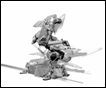
[1] college there are some machines, some desirable machines, that love to pretend to do more than they really do. In a pursuit of ‘pataphysics – the science of imaginary solutions – they never reveal their inner nature, their origins and illusions, genuineness and fakeness. Simultaneously speculative, fictional and accurately and efficiently productive, they navigate in the world of Yestertomorrowday, happily and innocently, walking briskly over the mountain of 20th-century rubbish. Using strange apparatuses, these ‘Alchimis(t/r/ick) machines symmetrically articulate different arrows of time and layers of knowledge, but more specifically they negotiate the endless limit of their own absurdity, where behavior that seems illogical is protocolized by an extreme logic of emerging design and geometry, where input and output are described by rules and protocols…Neither a satire of the worlds, a techno-pessimism nor a techno-derision, they are located at the limit – or constitute the limit – between the territory of conventions, certainties and stabilities where one can comfortably consider everything legitimated by an order, or an intuition of an order, and all other territories, whether produced by paranoia or fantasy or reported back by travelers…
In a casual and basic sense, machines have always been associated with technicism and used as the extension of the hand, through its replacement or improvement by accelerating its speed and power to produce and transform. But it seems very naïve to reduce machines to this first, obvious layer of their objective dimensions, in a purely functional and "machinism" approach, exclusively limited to Cartesian productive power, located in the visible spectrum of appearance and facts. Because machines also simultaneously produce artifacts, assemblages, multiplicity and desires and infiltrate the "raison d’être" of our own body and mind in the relationship to our own biotopes.
[2] Basically everywhere in nature, they are at the origin of all processes of exchange, transactions of substances, entropy and vitalism.[3] Machines are a paradigm for the body in the sense of its co-extensibility with nature, through processes, protocols, apparatuses, where transitory and transactional substances[4] constitute and affect simultaneously all species, their identities, their "objectivized and subjectivized" productions and their mutual relationships…In this pursuit of a polyphonic approach, we cannot overlook the concept of the "bachelor machine"
[5] as an attempt to integrate "machinism" apparatuses into a narrative of transaction and transmutation (in the alchemical sense). Contradictorily, these ‘Alchimis(t/r/ick)-machines operate as direct critique and denunciation of capitalist managerial reductionism, which replaced uniqueness and rarity with a system of repetition and standardization, erasing both the workers (when they are not becoming machines themselves[6]) and any singularities, any anomalies… providing products for a strategy of servitude which combined mass production and the production of the alienation of mass, as described by Walter Benjamin.[7] In opposition to this predictable ONE WAY dependency, bachelor machines simultaneously convey the fascination of this sophisticated human construction, its eroticism, its barbarian eroticism,[8] the "impulsion" and repulsion it generates, as a permanent schizophrenia alternating between its simultaneous potential for production and for destruction,[9] for a permanent dispute between Eros and Tanatos. They are vectors of both resistance and production, infiltrating the arrogance of the mainstream and revealing its schizoid values… The same industrial system produces both outcomes; their geneses are consubstantial, and their diametrically opposed collateral effects depend mainly on our ability to see and make visible that which lies beyond the mirror.In the work of R&Sie(n), ‘Alchimis(t/r/ick) machines try to reveal these disturbances, or are constitutive of them. The blurriness between what they are supposed to do, as perfect alienated and domesticated creatures, and the anthropomorphic psychology we intentionally project on them, creates a spectrum of potentiality, both interpretative and productive, which is able to re-"scenarize’’ the operating processes. A mind machine simultaneously transforms the real and our perception of what we consider real. In this sense machines seem to be vectors of narratives, generators of rumors, and at the same time directly operational, with an accurate productive efficiency. These multiple disorders, this kind of schizophrenia, could be considered a tool for reopening processes and subjectivities, for re-"protocolizing’’ indeterminacy and uncertainties. Agents of blur logic, of reactive and reprogrammable logic, the scenario created by and through these "machinism" processes asymptotically touch their own limits, revealing the fragile and movable border line between what seems to be, what should be and what should have been. The creatures produced by this machinism confront exterior forces, their ambivalence, their contingencies, their instability… They allow us to "exercise our power, to be conscious of our power, the consciousness of our power that is by the same token self-consciousness, consciousness of our vulnerability in the face of the enormity of this power."
[10]They cross the line of logic and walk in the fields of absurdity as an intentional value!
- For us and some others / absurdity is a strategy to expand the territory of "what could be," and simultaneously unbolt the locks on our mind and perception… and production…
- For all others / absurdity is a strategy to qualify the limit of "what could not be" and disqualify everything outside of the territory they previously defined.
Genetically Siamese and consubstantial, it appears as a dysfunctional reflection in the mirror, organizing the way "we and the others" frame conflicts arising precisely from the state of the mirror, to quote Lacan
[11] / Where the perception of the unicity of our corporality, through the mirror, is constructed in coincidence with the defragmentation of the perception of our environment. The process of "reductionism" to One Body is the symmetrical reflection of the One World, where all the complexities, the schizoid and paranoid assemblages, early childhood’s sweet disruption of consistency, are trapped in a univocal representation, framed and simplified. And consequently all the alien fragments that cannot fit in this perfect and comfortable representation of "INselves and OUTselves" are considered fatally flawed by absurdity, weirdness and oddity in order to preserve the illusion of this symmetrically operative but vain unicity. Beyond this point in childhood, we can never again experience the taste of "cul-bite-bouche-poil-chatte[12]", with this multiplicity of distance and territories (where animalism, animism, acephalous bodies (CsO) and consciousness are interweaved with guilt-free discovery…"Let me see: four times five is twelve, and four times six is thirteen, and four times seven is –oh dear! I shall never get to twenty at that rate!" said Alice in the "The Pool of Tears," but what appears odd is just a multiplication exercise using different bases and positional numeral systems… The confusion created by Charles Dodgson
[13] arises contradictorily from a mathematic construction, not from triviality or irony, and still less Alice’s childishness. The disqualification we carry out is a strategy to avoid seeing that which cannot be, "ce qui n’a pas de raison d’être," that which goes beyond our possible understanding and creates a "malentendu[14]" between our vision of the world as we have we simplified it (state of the mirror syndrome) and the contradictory complexity and "non sens" it generates as a permanent shadow theatre.Like Alice in Wonderland, we have to confuse our little girl’s perception with such apparatuses of "misunderstanding", stretching lines of subjectivization to organize the physical perception of our paranoia. Absurd protocols seem simultaneously markers and activators able to de-alienate the edges of the illusory "truth" system, in order to re-invert the logic of meaning and turn it into a multiple vanishing point… As we suppose the mirror is simultaneously a landscape with a double Janus face, a simple glass over a brick wall, a mathematic and geometric construction to extend light rays through the surface to trace the discovery of an optical logic, or… the door to some parallel universe
[15] sometimes simulated to symmetrically reproduce our own environment…Who said in the audience that we have to choose one? Who said that? I have to know…
The history of science was an ideal playground for this multiple disorder pathology… confronted by the denial and disqualification of "that which cannot be," sometimes out of ignorance but mainly because of reductionist conviction. The ideological dispute about the theory of heliocentrism
[16] could be one of the best paradigms for the fragile boundary between official logic and infringement illogic, as the substrate, the loam for the absurd substances that sprouted until they finally reframed the frontiers of our knowledge… by metabolizing what was previously considered toxic to our framed and "bourgeois"[17] equilibrium.‘Alchimis(t/r/ick) machines seek to articulate things and minds, objective and narrative production, "machinism" causalities and unpredictable dependences, to interrogate their "raison d’être "and the eroticism of their transgression, weaving together the malentendus and the illusions they generate, in a different arrow of time:
"Here and now" as a live transaction, "here and tomorrow" as an operative fictional scenario, "Elsewhere and simultaneously" for
speculative and political research... navigating between apparatuses of "animism, vitalism and mechanism".The tools of mechanization drift from a self-organized urbanism (an "architecture des humeurs")
[18] to a stochastic machine with a predictable completion (Olzweg),[19] from the "machinism" ghost of a wild DMZ forest (heshotmedown)[20] to a paranoiac uranium laboratory (TbWnD),[21] to a simple transportation machine, a stargate experiment(Broomwitch).[22]Their ‘alchimis(trick) and skyzoid agendas are both products and vectors of paranoia.
[23]---------------------------------------------
Footnotes
[1] A reference to the Collège de 'pataphysique founded in 1948 in honor of Alfred Jarry. We could consider the OuLiPo (Ouvroir de littérature potentielle, Workshop of Potential Literature, whose members included the mathematician François Le Lionnais and Raymond Queneau) the first branch of that group, and the ‘Alchimis(trick) as a rotten branch of that branch. [2] A reference to the work of Ilya Prigogine, who considered human beings a "mechanism" of exchanges, of shared substances IN and OUT and vice versa. [3] "Vitalism presumes a monadological rather than atomistic ontology. In Leibniz’s ‘monadaology’ all substances are different from one another, whereas its opposite, Cartesian ‘atomism,’ presumes that matter is comprised of identical parts (atoms)." Scott Lash. [4] "All bodily phenomena can be explained mechanically or by the corpuscular philosophy." Leibniz, Letters to Arnauld. [5] Developed by a multitudes of artists, philosophers and writers such as Duchamp, Poe, Kafka, Deleuze and even, subconsciously, Cervantes. The term "bachelor machine" was first used by Marcel Duchamp around 1913 in connection with pieces of work that would later be assembled in the Large Glass of 1915-1923. For Deleuze and Guattari, the "bachelor machine" forms a knot between desirable machine and the body without, to create a new myth which seems to articulate Narcissus, Opheus and Sisiphus. It has been isolated by Michel Carrouges (in his book Machines ceìlibataires / Arcanes, 1954) [6] As seen in the organization of Henry Ford’s Detroit factories (Fordism). [7] Walter Benjamin, "The Work of Art in the Age of Mechanical Reproduction," 1936. [8] From Poe’s "The Pit and the Pendulum" and Kafka’s "In the Penal Colony" to Ballard’s Crash. [9] The latest subculture icon: Avatar, where the metempsychosis machine saves the ecologically-balanced Ewya Kingdom from the caterpillar machine which destroys the blue hobbits’ dreamtimes. The both are coming from the same "tea pot". [10] Recorded lecture by Gilles Deleuze at the University of Paris-Vincennes in 1980. The exercise of our power as Nietzsche and Deleuze understood it, as a gift, a creation, and not the kind of dominance that they (the machines) could grant us. [11] Le stade du miroir. Théorie d'un moment structurant et génétique de la constitution de la réalité, conçu en relation avec l'expérience et la doctrine psychanalytique 1937. [12] "Ass-Dick-Hair-Mouth-Pussy" as the nearest reachable, fragmented environment. [13] The mathematician Charles Dodgson wrote under the name Lewis Carroll. [14] A malentendu is something between mishearing and misunderstanding. [15] In physics, quantum mechanics: Universes separated from each other by a single quantum event. [16] From Ptolemy to Hipatia of Alexandria, Copernicus, Galileo and Kepler to Einstein. [17] In the Marxist sense, the social class that owned the means of production in the 19th century and now owns, through the media, culture, the means of manipulating desires and subjectivities (Antonio Negri). [18] An "Architecture des Humeurs" / 2010. [19] Olzweg / 2006. [20] Heshotmedown / 2009. [21] The Building which never dies / 2009 -10. [22] Broomwitch / 2008. [23] In both senses, "critical paranoia" and pathological paranoia. Used before by R&Sie(n) in the book BIO[re]BO[o]T
___________________________________
BIO[re]BO[o]T
Ecosophical apparatus & skizoïd machines
“ …in power games, [apparatuses could be considered] relationship strategies supporting types of knowledge and supported by themselves.” Michel Foucault, Dits et Ecrits)
Machines are always pretending to do more than what they were programmed to do. It’s their nature.
Their behavior alternates phantasms, frustrations and fears inspired by their own ability to break free and threaten us.[1]
The blurriness between what they are supposed to do, as perfect alienated and domesticated creatures, and the anthropomorphic psychology we intentionally project on them, creates a spectrum of potentiality, both interpretative and productive, which is able to re-“scenarize’’ the operating processes of the architectural field. Machines are a vector of narration, generators of rumor, and at the same time directly operational, with an accurate efficiency of production.
These multiple disorders, this kind of schizophrenia, could be considered a tool for reopening processes and subjectivities, for re-“protocolizing’’ indeterminacy and uncertainties. In this way, they become agents of blur logic, of reactive and re-programmable logic.
As in Alice in Wonderland, where Lewis Carroll used mathematics to confuse a little girl’s perception, such apparatuses, including ‘’bachelor machines,”[2] stretch a line of subjectivization to organize repetitions and anomalies[3] using and developing paradoxes that are able to re-complexify and de-alienate the edges of the truth system, in order to re-invert the logic of meaning and turn it into a vanishing point…
7 6 10 5 5 8 9
It seems to make strategic sense to evaluate architecture’s degree of reality on the basis of its ability to tell stories and in this way enlarge the dimension of its physicality. In a sense, we should consider the structure itself as a fragment of a scenario, a MacGuffin, the point where and from which speeches, strategies, scientific protocols and power games articulate stories and agendas.
Misunderstandings, in this sense, produce artefacts – in “the garden which forks nowhere’’ – and apparatuses can be considered generators of ambiguities and knowledge where non-shaping protocols, protocols of emergences, contingently reveal the conditions of emission and are revealed by them, in a Situationist[4] strategy.
The seven BI[r]O-BO[o]Ts should be considered a preliminary spectrum, from a speculative self-organized urbanism (Iveheardabout)[5] to a digestive physiological experiment (thegardenofearthlydelights).[6] Within these endpoints are a stochastic machine with a predictable uncompletion (Olzweg),[7] an industrial milling machine for anthroposophic transactions (waterflux),[8] a hydroponic Hitchcockian ‘’Rear Windows’’, (I’mlostinParis), a standing up machine, as a Darwinism evolution from a André Bloc house to its extension (broomwitch)[9] and at last but not least, a pure chimera hybrid bio-robot – the mechanical ghost of a wild forest where cold war degrades nature (heshotmedown).[10]
Their skyzoïd-machinism agendas are both products and vectors of paranoia.[11]
[1] As the Golem did to its own creator, the Rabbi Loeb.
[2] In the sense of Marcel Duchamp & Picabia.
[3] In the sense of Difference and Repetition, G. Deleuze, 1968.
[4] La société du spectacle, Guy Debord 1967 / Declaration d’Amsterdam, Constant and Guy Debord, 1958.
[5] Iveheardabout – details of concrete secretion robot (legs and nozzle).
[6] Thegardenofearthlydelights distilling-sublimating-drying-extracting devices.
[7] Olzweg – stochastic machine
[8] Waterflux – prototyping scale 1
[9] Broomwitch – transport and standing up machine
[10].Heshotmedown – a chimera robot.
[11] In both senses, “critical paranoia” and pathological paranoia.
___________________________________
(Science) Fiction & Mass Culture Crisis
Immersed in a vibrating[1] stopped time, we follow time’s arrow – which since the 1960s has not been sure exactly which way it’s going, vacillating between the moral conservatism of the baby boomers and Gucci consumerist futurology.
Leaving behind its Galilean scrutinizing of the future, an exploration of inaccessible worlds that only Science (fiction) from the heights of its certitude could drive, (science) fiction has slipped into the meanders of our digital society. The false footsteps of Bibendum (the Michelin tire man) in the dirty dust of the moon that day in July 1969 marked an end to our entropic flights of fancy. The books of Stephenson, Gibson, Stirling and others, while marketed as speculative fiction, were in fact live broadcasts, and the funhouse mirror that the genre tended to create between the space of the imagination and that of our daily lives expanded throughout a universe of plausabilities and melted into the news, with all its social dimensions.
Astonishingly, (science) fiction has shifted neither forward nor rearward but into the here and now. The unfolding scenarios it follows to manipulate our reality are becoming true transformation tools and paradoxically strategic levers to grasp the wobbling of our postdigital societies, our choked mass media culture.
But the main interest of this sudden in vivo matrix immersion lies in the anxieties it provokes.
Instead of Science (fiction) remaining a domain for positivist and determinist propaganda, it should nourish the seeds of our own monstrosity – our own loss of control amid indeterminism, chaos theory[2] and biogenetics – as a force striking alliances with harpies and earthly creatures, the Faustian Dark Side and the Sturm und Drang, against the rationalist wigs and the works of the Hegelian spirit, and open up to a world where even fears become fable, as lovely as they are carnal.[3] We have to negotiate with the fold of the instant, the invagination of the thought of the future, and live in a present that is like an asymptotic bend in time, between Back to the Future and Tomorrow Now,[4] between dream time and the day after.
Under these paradoxical conditions where the notion and perception of time are crushed on the surface of immediacy, how can we believe that architecture can only be constituted by fossilized avatars, blind cadavers exquis of naïve and progressist values,[5] by quotational opportunism disguised as global entertainment?
To reclaim the scenarios and substances that condition architecture and reveal the contradictions and fantasies that drive our societies, we need, on the contrary, to draw on this vibrating, disquieting and voluptuous temporality.[6] Architecture is not something to be thought or produced for later, like the standard bearer for a morality. It can only be negotiated live, in its contingency on a situation and its solubility in a set of givens.
This critical and territorialized attitude is in sharp contrast to macrocynical flights of fancy (the market creates the form!) and their remake of international architecture[7] (New York, Paris, Berlin, Shanghai, Singapore) and instead launches processes that reactivate the concept of a throbbing,[8] complex[9] and unfinished[10] “localism.”
Our tools for the codification and transformation of territories work not through an ideal projection but a local inventory,[11] a mutant and tangible biotope, issued from the generalized bankruptcy of urban thought[12] and its deception. This ambiguity gives rise to our unstable and unique scenarios.
The folded rhizomes of Guattari/Deleuze were a point of fusion and arborescence to attain an nth plateau,[13] a terra incognita, to break out of the grip of those who declared that they had discursive, pedagogic and linear authority. That made it possible for us to escape from Promethean dreams, millenarian apostles and cynical moralists, and walk gaily over the many and multiple dustbins of the last century, unburdened of the confusion of progressist mythologies, in the voluptuousness of a quotidian cataclysm.
(Science) “fictional”[14] architecture is not a cultural remake of the Altered States[15] variety for the elite. It has nothing to do with a nostalgic idealization of the world in a museum soap bubble, nor a New Age utopia with its kindly moral presuppositions.
Recognizing the new principles of reality, it is a space of confrontation, ceaselessly investing itself in new procedures for the reprogramming and rescripting[16] of existence, here and now.
By necessity, it confronts its emergence, its Gestalt, and can only be negotiated in the visible spectrum. That is its political and operational condition. It generates processes of transformation that take the risk of critical positions and mutations,[17] on the razor’s edge.
There can be no pleasure in announcing the “infocalypse”. We can only harvest its often strange fruits. The following projects are a few paradigms.
[1] Stanley Kubrick touched off the Big Bang, setting the clock back to zero in '67 / Clockwork Orange and 2001 like opposite sides of the same mirror / Dream Time and the Day After simultanously / NASA and CIA, autistic hostages, two copulating Siamese twins. Because of or maybe thanks to him, ever since we've been stuck in that double bill, a scratched record stoptime without past or future, enjoying our stay between heaven and hell in Bosch's Garden of Earthly Delights.
[2] Over the course of time all systems become progressively disordered as they approach their final state of total equilibrium (the second law of thermodynamics). In order to track our environment, physical sciences born out of the study of turbulence, vibration, disequilibria and probability have taken the place of the linear sciences where things are viewed as following a quantitative and determinist path.
[3] One percent of the three thousand polar bears (Ursus maritimus) in Svalbard are hermaphrodites, with a vagina and a penis. The conditions for survival at the North Pole, including Soviet nuclear waste materials carried by the Arctic Stream and the carbon effluence of the Gulf Stream, have allowed us to observe the first natural mutation.
[4] Bruce Sterling, Tomorrow Now, Random House, New York, 2003.
[5] How can we reconcile the need to save the Amazonian rainforest and at the same time our fascination with the bulldozer (a sort of Caterpillar with beetle pincers) that is cutting it down? This dual attitude protects us from ecologist alibis, “primitivist” dreams of purity and of the Heimat, as well as from becoming enslaved to the mechanisms of the tabula rasa. Architecture consists of revealing these two contradictory dimensions, in their constant tension.
[6] “Yet this landscape of terror is also, as in Bosch, voluptuous and nearly infinite in irony. Reminding us that hell is full of laughter, we could call this cataclysm where everything bad is foretold in dark humour, a black utopia.” Mike Davis, Dead City, The New Press, 2003.
[7] One could suspect that the “Be global and fuck local” attitude is nothing but a passport that allows countries that can afford to hire a Koolhaas or a Nouvel to become integrated into the World Corp. But why not!? The vulgarity lies in their duplicity. They may be in Lagos, at Prada or a certain floating Pavilion, but they want to lecture us about political consciousness.
[8] Dust and pollution in Bangkok, mosquitoes and Nile River Virus in Trinidad, “hairs in the Snake” and “bovine heat” in Evolène, the bush scorched by sun in Soweto… these are the human and territorial raw materials that condition the local scene. Contrary to what Plato says in
his Parmenides, where he doesn’t bother to hide his distaste for what he considers ignoble elements, the lowest layers of being – materials like hair and dirt – are no less constitutive elements of urban economies, even if they issue from bankruptcy of city planning
[9] Complexity comes from the entropic dimension of a system, between chaos and chance. Another aspect comes from its situation between two different and even contradictory states. Complexity is not driven by autonomy but by reactivity, and cannot taking into account to all that surrounds it. It is in this sense that disturbances of identity, stealth and hybridization become modes of operation. This is reflected in our own indecisiveness, our inability to “choose between…” to “make to do with…”.
[10] In this regard, consider how Jules Verne completed Edgar Alan Poe’s Narrative of Arthur Gordon Pym. Poe’s last, enigmatic phrase leaves the reader perplexed and frustrated: “But there arose in our pathway a shrouded human figure, far larger in proportions than any dweller among men. And the hue of the skin of the figure was of the perfect whiteness of the snow.” Afraid by this ghost, Jules Verne, in his sequel, Le Sphinx des Glaces (The Sphinx of the Ice Fields), twenty years after, unfold this fiction: “No! These were physical facts, not imaginary phenomena… This massive shape (the shrouded figure) was nothing but a colossal animal… whose power produced effects as natural as they were terrible.” Poe’s novella was published in serial form purporting to be an authentic report from an expedition to the South Pole that never actually took place. The piece is disturbing, a source of endless questions, and prefigured Poe’s own death. The fact that a half-century later Verne brought it back to life to bring the story to an end reveals the oppositeness of the two men’s attitudes: the former scripts and opens the narrative in its non-finitude, while the latter plans and encloses it within the same operational modes as urban planners, full of Fourièrist alibis, Colbertist swindles and the predictions of "knowledgeable" people.
[11] These two models of territorial intervention are diametrically opposed: one employs reasoned and accepted Euclidean forms issued directly from geometric abstraction (deconstructed or not), laid down like a conceptual or mental grid over a particular place. The other is entirely different; it seeks to exacerbate a response by extending the complexity of the site itself. One dominates the territory in order to prove mankind’s domination of the situation, the other folds back on itself, hollow, so as to let itself be absorbed by the pre-existing equilibrium.
The first is a pure projection of the mind, the Hegelian spirit, facilitating the consumption of concepts and images in an extension of modernist ideals; the other – mutant, extracted from the previously existing, more complex to obtain – in contrast suggests that, “In the absence of ideas, we would have to observe.”
Like a chemist who has conducted an experiment in order to reread it and understand it, this empirical and aleatory process is constructed through induction and deduction. Depending on the project, the skin of the photographic or cartographic image mutates and metamorphoses through aspiration and extrusion, folding, heaving, pollution… The pixels, fractal fragmentations of reality, are recomposed in a series of genetic mutations. The context is no longer idealized, conceptualized or historicized; it is the substratum of its own transformation. There is a political difference. This mutant and thus imperfect dimension permits us a glimpse of technology not as the fantasy of one more progressist assertion, but as a tool of contextualization, hybridization and complexity. Beyond the fascination for technological tools and factitious metamorphoses that they engender, what concerns us is its operational function. It is no longer a question of counterposing a project and its context, like two distinct hypotheses, but of linking them through the very process of transformation. The project no longer issues from an abstract projection, but from a distortion.
[12] On the contrary, we have to handle contradictions like that of the island of Tuvalu in the South Pacific. Because of its low altitude and changes in the oceanic water level (due to global warming), a plan for its evacuation has formulated as an objective given.
[13] “This is what the people of Stateless had in common: not merely the island itself, but the first-hand knowledge that they stood on rock which the founders had crystallized out of the ocean – and which was, forever, dissolving again, only enduring through a process of constant repair. Beneficent nature had nothing to do with it; conscious human effort, and cooperation, had built Stateless… the balance could be disturbed in a thousand ways…. All that elaborate machinery had to be monitored, had to be understood. …It had one undeniable advantage over all the contrived mythology of nationhood. It was true. Greg Egan, Distress, Harper Prism, New York, 1995, pp. 171-172
[14] Fiction differs from utopia in that it does not seek to be right. Why would we seek to be right when there are so many people who carry the banner of morality – they are legion, as dangerous and common as criminals.
[15] A Ken Russell film where research into chemical hallucinogenics ends in a polychrome and simian apotheosis.
[16] “What’s the scenario? A constantly mutating sequence of possibilities. Add a morsel of a difference and the result slips out of control, shift the location for action and everything is different. There is a fundamental gap between societies that base their development on scenarios and those that base their development on planning.” Liam Gillick,“ Should the future help the past ?,” Five or Six Previsions, Lukas and Stenberg, Ltd., New York, 2001
[17] See R&Sie’s Aqua Alta 1.0 and 2.0… amid laguna pollution, technological suspicion and hybrid mutation… in both cases, this is a critique of relational mechanisms.
____________________________________________________________________
____________________________________________________________________
The almost ecstatic energy and interest R&Sie is investing in decay and contextual alienation in any project can be met on the critic’s side with the perverseness of a construct such as freshness. Freshness has a double anchorage in physical and perceptual realms. With respect to organic matter, it is immediately given as a time-dependent construct, uncomfortably dwelling the very close vicinity of degradation, decomposition and decay. The force of R&Sie’s architecture resides in the endorsement of this fragile physicality, revealed and exploited as an indication of vulnerability - of time, of matter, of architecture, and of a situation’s pre-existence. This vulnerability can only be given in the visible, in the changing gestalt of matter-form, in a formal play with empirical content from which no purity is ever allowed to be extracted through abstraction, projection or idealization. R&Sie deliberately abandons the pompous and heroic role of the architect as the creator (demiourgos), transformed into that of a process engineer, a form-perverter. Architecture builds out of all the physiological processes that occur simultaneously on matter and form in regard to their territorialization; form-making turns out into a form-perversion process, into a hilarious and jubilant formal processing of putrescent and rotting material, conveying a high sense of quality and appetite appeal, of delicious decay, impelling for a new aesthetic and perceptual consumption. R&Sie plays with the organic in the manner of a bio-entrepreneur, experimenting with the chemical, physical biological and topological changes followed by changes in the state and form of matter from a previous equilibrium. The way R&Sie expresses, reveals and exploits changes in the sensory qualities of matter, these physical transformations of a geography come then as another indication for comprehending porosity and the vulnerable proximity and sensitivity of freshness to decay.
The tension of this oscillation echoes further the frenetic insistence on the here and now, on the negotiation with the instant, on the refusal of any historicisation in favor of the immediacy of an architectural production. This production, which is not allowed to extend into any futuristic projection, makes a playful refurbishing of the 20th century junkyard: Freshness starts from the genuine use of decaying historical material, adding to its life-time while keeping up the immediacy of the work. Immediacy appears then as a possible freshness parameter to measure the deviation between a formal historical repertoire, with its in-built gestalt, and its current perturbation by R&Sie in both hilarious and disquieting fictions.
These fictions, which the architects themselves call scenarios, are actually reminiscent of the concept of play developed by Gadamer[i]. The work calls to play, the play-fiction is drawing the players into itself, absorbing and dissolving their subjectivity. From this dissolution of subjectivity, comes forth the notion of a soluble architecture and emerges the tacit consciousness of already being a player. The architect is but one of the players in this play. The play-fiction is non-linear, non-predictive and non-purposive. In a way, it recalls the open scenarios of soap operas in which the scenario unfolds with respect to the wishes and reactions of the spectators, evolving in an indeterminate way that cannot be anticipated by its very authors. The play-fiction produces an interactive design device, an architect-player-citizen interface acting as a mode of operation negotiating with our troubles, fears, fantasies and perversions while revealing and confronting us to this very transaction. R&Sie delineates there an ethical-political stance that looks forth for compelling play-fictions for the design and dwelling of new territories. A genuine poetic expression unfolds through the scenario and comes to update and expose the flaws and totalitarianism of all utopia, of all social engineering, of all determinism. The scenario acts as creative and critical compost in which resources, materials, energies, sources, structures, territories, and species syncretise with a deliberately non-anticipated outcome. In this un-founded and non-hierarchical synergy melt down technological, aesthetic, social and political layers, to which the natural and the artificial open simultaneously. R&Sie invites all species, human as well as non-human, in an architecture constantly including animals or insects as forgotten inhabitants of territories. An architecture of hybridization playing with the real, the fictional and the mythical opens before us a pagan atmosphere with a strange taste.
____________________________________________________________________
____________________________________________________________________
@morphous MUTATIONS
by François ROCHE, 2000
I had to admit defeat. Something wanted it that way. I, too, was just an instrument. The world was nothing more than an infinite interweave of instruments. The respite had only lasted for as long as the mirage that it was.Les Racines du Mal, Maurice G. Dantec, Série Noire, 1995
Sites and territories nurture identities, preconditions and affects that architecture and urbanism have continuously restrained and eradicated. The architectural object, having claimed authority for four centuries1 has the power of unparalleled destruction of modernity to maturity. But in so doing it signs its own limits and end.
The numerous ‘aesthetic orthodoxies’ born in the antechamber of reason and the wastedumps of ideology have now not only become unworkable but are also criminal in their discrepancy with society.
Judging each operation on the validity of hypotheses within an enormous assortment of ever increasing facts and artefacts is not an easy task. Signs and referents are not pre-given, like a symbolic reference, but have to be discovered in real time, on the ‘real site’.
If architecture did not know or could not substitute for the modern culture of breaking in a culture of place, more attentive to what it was bulldozing, it is that the verse was already in the fruit. In short, a genetic error... The horizons of the world of perception, of corporeality and of place have only too rarely been the mediums of a production.
Territorialising2 architecture does not mean cloaking it in the rags of a new fashion or style, which would be just as out of such and separate from the styles and fashions already consumed. Territorialising architecture in order that the place gains a social, cultural and aesthetic3 link means inserting it back into what it might have been on the verge of destroying, and extracting the substance of the construction from the landscape (whether urban or otherwise), whether a physical, corporeal substance within it, or climates, materials, perceptions and affects.
This is not historical regression, nor modern projection, but an attitude that affirms itself by what it doesn’t belong to, outlined against a razor’s edge, in permanent equilibrium. It is a process that is renewed at each new place, allowing for an in-situ attitude rather than just another aesthetic code. From that a radical displacement of our function can be born.
To identify that which characterises a place is already to interpret it and to put forward a way of operating on it. But linking being to its ecosystem can only save linking the body to the body of architecture.
This process of reactive mimesis is not a simulation of the ‘exquisite corpse’ game, a visual avatar, disappearing and camouflaging itself with an ecological alibi. Its ability to take hold of a territory without subjugating it depends on the unclear identity that develops within it, on the transformation it operates, on the gap of its implementation, on the ambiguity of the network of extraction/transformation that the materials have come from.
This antidote to the separated,4 autonomous body, this ‘live’ production process could not operate were it not nourished by these active materials: ‘there are the images of materials ... sight names them and the hand knows them’.5
In order that these ‘barren’ propositions do not add, subtract but rather extract, and in order that the object of architecture can spur on the real, like a contorted alterity of the territory in abeyance, we should, perhaps, shift the origins of architectural referents into a precondition that states ‘there is’.
We had spent several years looking for the instrument that would enable us to explore the minimal act, somewhere the not-much and the just enough, where the territorial change stemming from architecture would be steeped in prior geographies, where the development can work its way in, and embed itself in what it was supposed to dominate, to exacerbate issues of mutation and identity.
We were after an instrument that would enable us to introduce strategies of hybridisation and mimesis in the "here and now" of each particular situation. In view of the many different manipulations of history, involving morality and heritage alike, geography and cartography — and not the tracing, as Deleuze and Guattari 6 remind us — have always seemed more operational to us.
But to contrast the already existing site with its future, in an encounter between the image of the exposed context and the image (in photomontage) that embraces the architectural project, like the demonstration of a processing economy, was not enough for us. We were missing the grasp of the process, in the breakdown of successive hypotheses.
Despite formulating hybridisation scenarios (Fresnoy, Magasins Généraux, House in the Trees, Berlin, Sarcelles…), the medium was lacking. The mutations not only never appeared in the movement that had given rise to them, but, even more so, the documents, in the final analysis, could, by virtue of their isolation, be re-interpreted as decontextualized artefacts.
The processes of distortion, originating from morphing, and here presented by serial tapes or elsewhere on videotapes, stem from this dearth and open up a field of possibilities. Over and above a fascination with the technological tool, and with the contrived metamorphosis that it creates, we are exercised by its revelatory and operational function.The more "deceptive" the morphed movement seems, the more inert in its transformation, the more the urban and architectural project seems to be dominated by the prior situation. The more the morphing can be read in its artifice, the more the projection seems, this time around, to be deterritoralized. Unlike an instrument of representation, morphing thus reveals the degree to which the hypotheses are decontextualized, and in an on-going back-and-forth between deduction and induction, a re-reading of the successive phases will validate or invalidate the relevance of the choices, in a making with to do less strategy 7.It is no longer a matter of contrasting the project with its context, like two distinct hypotheses, but of linking them together by the actual transformation process.
The project is no longer the issue of an abstract projection, but of a distortion of the real. The blank page and the empty screen cannot be.
This software calls for a body, a generic physical matrix.The skin 8 of the photographic, cartographic image is transformed and metamorphosed by aspiration (Aqua Alta in Venice), by Scrambling (Farm in Swiss), by Overflow (Restaurant in Japan), by Extrusion and Contraction (Tave House and Maido Museum in Reunion Island) by folding (Soweto museum in South Africa), by growing Pilosity (Tower in Paris), by shearing Territory (House Barak in France and Rotterdam urbanism)…
And the pixels, fractal fragments of the real, are put back together again in a series of genetic mutations. The context is no longer idealised, conceptualised or historicised, it is rather an underlayer of its own transformation.
This is a political difference.
The virtual instrument paradoxically becomes a principle of reality.
A few words of explanation :
Morphing lies at the root of a software which makes it possible to merge image A with image B by means of a topological shift of salient dots. With the "Warp" technique, which is a variant of this process, it is possible to produce this alteration, but without being aware of the resulting B. Image A can thus be easily manipulated, and distorted, when it comes into contact with a programme and a scenario, but it cannot side-step its own matter, it own physicality, by resisting it. And it is this amorphism that is involved here.
Presenting the conditions of a hybridisation and a transformation that are paradoxically static and which, by virtue of the mobility/immobility that they create, reveal at best the various issues of prior identity and geography. It is tantamount to producing a critical state both on the "territorial development" processes but also on the use and misuse of technologies.
Doing nothing is to raise questions and problems, alike. Doing things on the map, by way of these "@morphous Mutations", is like trying to do things from the negative angle, without the preformatted and accepted skills. The model already in place obliges us to switch our skill towards other arenas (social mechanisms, political economics, and territorial challenges). This process thus opens up areas of investigation likely to extricate us from the dictate of modern projection (medium and alibi of 20th century architecture), which has muddled the programme with the declaration of functions.To make the architectural object ambiguous, and to force it out of the real, is to question our own perception 9.
Nothing seems more pertinent to me than an architecture that straddles such ambiguities. The binary structures of the predominant thinking about heritage/modernity and servility/domination have, happily, imploded. The transformations of the body and its sexuality, using silicone and collagen, as a diametric opposite of the Metropolis Cyber-Robot, are the lead-in to this. The contemporary prosthesis is made of flesh, and the functional outgrowth made of artificial skin is re-formed.
The body is not denied, but exacerbated and hypertrophied.Technology thus enables us, by way of these "@morphous Mutations", to involve processes and write scripts which reactivate the concept of "localism", not to serve up dishes again that have got cold, and museified models, but a thrilling localism, made up of contradictions 10 and respect, and reactive membranes, in an elastic topography.Identifying what characterises a place by these new tools is already tantamount to putting forward a new operational method.
So there's not much point in doing a whole lot more.
_________________________________________________________________________
1 Brunelleschi’s perspective geometry is responsible for this, in the rationalisation of instruments of production and the domination of architecture on the site. The rule of visual representation is thus substituted for corporeal perceptions.
2 See the notion developed by Felix Guattari in his Schizophrenia Analytic on ecosophy, that architecture has ‘imploded’ and is condemned to being pulled and torn in every direction.
3 In sense attributed to it by M Maffesoli, Du Temps des tribus, 1988, ‘History can promote a morale (a politics), the space will favour an aesthetic and exude an ethics’.
4 See Augustin Berque’s La Théorie du paysage en France.
5 Gaston Bachelard, L’Eau et les rêves, 1942.
6 "The rhizome is quite different, map and not tracing… If there is a contrast between map and tracing, it is because the map in its entirety is oriented towards an experiment to do with reality. The map does not reproduce a subconscious that is closed in on itself, it constructs it." Gilles Deleuze, Félix Guattari, Mille Plateaux, Les Éditions de Minuit, Collection Critique, 1980.
7 "Making with to do less", R, DSV & Sie. P, L'Ombre du Caméléon, IFA/Karédas, 1994.
8 "These tear the body within and seek a hole to escape through, it throws its hands on to the body and they vibrate under the fingers ; it pushes them towards the joints, towards the cavities of the belly and throat, it crushes them there, its fist digging into the skin, which, bespattered with blood beneath, turns cold." Pierre Guyotat, Tombeau pour cinq cent mille soldats, L'imaginaire, Gallimard, 1967.
9 L'Hiver de l'Amour/The Winter of Love, Musée d'Art Moderne de la Ville de Paris, Paysage/Landscape nº2, R, DSV & Sie. P. An installation on the stairs. The fitted carpet was laid, the height of the steps slightly altered, and the carpet relaid. A study to do with the dissociation of the senses, between what was perceived (the treads) and felt (a moving topography), March 1994.
10 "How to live by following — not without fascination — the bulldozer's passage in the Amazonian forest and campaigning for its protection… while remaining on the razor's edge. It is with this terribly human dimension that we must work. An admittedly schizophrenic attitude, but one which preserves us from the snares of the clear conscience, environmental activism and destructive forms of extremism." Lecture at the Pavilion de l'Arsenal, F. Roche, 1997, Mini-PA.
____________________________________________________________________
____________________________________________________________________
Transforming Continuity
by
Andreas Ruby, 2002
It is not easy to grasp the architecture of R & Sie... Rarely their projects appear as compact buildings. Often they disappear in their own context, as if they tried to avoid to colonialise it with their objectivity. The borders between figure and ground become fluid, uncertain where the building starts and the context ends. This undifferenciability is no deficiency, but formulates the antithesis to the modernistic ideology of the tabula rasa. Instead of breaking radically with the past, R & Sie... virtually scan the environment for points of contact, in order to propell them through a transformatory movement into a new constellation. Hence their own intervention is less to be understood in terms of an implantation, but rather as a shift and refinement of information already embedded in the context. While the generation of progress in modernity was usually achieved by an annexation of the existing through a new order (which equals a replacement of the real), this strategy of infiltration brings about a blurring of the categories. The dialectics of old and new evaporate in a gradual transformation, which permanently reorganises the environment and thereby creates ‘newness’.
When R & Sie... was founded as a practice in the late 1980’s, the unease with modernity already pictured a fundamental scepticism of architecture towards the project of the avantgarde. The concepts however, which were introduced as alternatives, were nearly always of a retrogressive nature. The critical regionalism of Kenneth Frampton demanded a move away from the norm of the international style, pleading for a re-animation of historic references and local building culture instead. Josef Kleihues, the organiser of the International Bauausstellung in 1986, reduced the project of contemporary architecture alltogether to what he termed a "Critical Reconstruction of the European City". All of a sudden, any connection to the present seemed only possible by returning to traditional urban and architectural models. History became an Über-Ich, which architecture had to subordinate itself to.
By contrast, R & Sie...’s critical reading of modernity calls for a transformative continuity to the existing; a continuity, which gives way to a new notion of territory, whose ‘genius loci’ ceases to be the spiritualised extract of its historic past, but is constituted by the totality of its material states. Yet soon it became clear, that architecture was lacking the necessary techniques to open up this new territory. For if architectural plans define the space within a building very well, the context seems to occur in them merely as an absent projection surface, as a blank spot on a map, which seemingly becomes a place with characteristics only by placing a building on it.
Thus it marked a paradigm shift, when architects like Greg Lynn and Bernard Cache introduced computer aided design-techniques to architecture during the mid-1990s. Animation software packages used in the film industry such as Soft-Image (later Wavefront and Maya) opened up unknown possibilities to the manipulation of space, resulting in an equal treatment of figure and ground as never before. The binary opposition of existing context and a project yet to be developped gave way to the inclusive notion of a territory with concrete characteristics – flexibility, gravity, erosion, energy flow, circulation etc. Once animated to a three dimensional virtual model, the digitised territory could be processed as a dynamic form. As a result, the modification of its material parameters leads to a process-based mutation of matter, which turns out to have little in common with the traditional logic of sculptural space.
In their later work the pioneers of computer-animated architecture, foremost Greg Lynn, paradoxically focused on designing the architectural object only, in order to apply ever new topological geometries onto them. For R & Sie... instead, the primary potential of animation does not lie in the creation of a new formal vocabulary, but in the ability to map the characteristics of a place and directly apply them to its own transformation. If the architecture of Gregg Lynn, due to its formalist fixation on the object, ultimately reinforces the dialectics of the building and its context, R & Sie... are using animation with the goal to precisely abolish this dialectics.
Furthermore, their interest to interweave an intervention with the found situation, is not limited to the mere materiality of space, but includes its semantic and programistic dimension as well. A rather unusual combination, as the concentration on the ‘digital paridigm’ of architecture in the 1990’s was paralleled by a general aversion from working with philosophical, political or historical systems of representation. Instead, an almost exclusive investigation into ‘material organisations’- such as the choreography of vast circulation of humans and goods – takes the place. A preoccupation, which in its last consequence will lead to a semantic emptying of architecture.
In this respect too, R & Sie… take a different position to the mainstream of contemporary experimental architecture. In fact, the semantic dimension of places does play an important part in their projects; however in a way which is diametrically opposed to the contextualism of the 70’s and 80’s: thus a place is no longer a topographical archive filled with embedded traces of the past, wich are only waiting to be excavated as artefacts in the present. To R & Sie…, territory and information fuse to the hybrid entity of a territorially embodied information. Consequently the abstract idea of a place materializes to a multitude of concrete places, in the same way that history as a given universal reality differentiates into numerous stories.
These places are in fact charged stories, stories very much in the cinematographic sense. In order to make these stories effective for an architectural project, R & Sie… introduce another cinematographic instrument: the scenario, which in architecture proves to be just as useful a tool for structuring stories in space and time. Yet, unlike in film, the scenario was never given a methodical place in the design process of architecture. Hence the scenario must be virtually grafted into the design process at some point, if you want to working with it. In the procedure of R & Sie… it is the program that acts as the secondary structure to implement the scenario. This decision explains the enormous importance of the program in the architecture of R & Sie… – which again lets the practice stand out from the mainstream of contemporary architecture, in which the program rarely plays a generative role. After being ideologically hyped during the functionalist era, the program degenerated soon to a minefield for architecture, which was carefully avoided (with only a few exceptions like Bernard Tschumis’ early works such as the Manhattan Transcripts). The architectural pragmatism of the present treats the program merely as an extra-architectural affair, which is essentially put up with and more or less directly extruded in space. To R & Sie… though, the program represents an immanent condition of architecture itself, a virtual ‘building’ prefigured already in extension and program, who’s shadow already embraces the place and thus threatens to vanish the latters own reservoir of stories. Evidently R & Sie… are as sceptical of this virtual tabula rasa as they are to its real pendant. Thus as much as the architectural object is worked continuously into and extruded out of the territory, the program too is negotiated intensely with the local condition of the place.
To R & Sie… working the program is indeed a constituent prerequisite of their architecture. Before unfolding a program in space, they need to organise its relationship to the existing - which in many cases means re-writing the program. In the case of their project "Maido" "Maido" (Ile de la Réunion, 1995-96), the project essentially foresaw an exhibition building for contemporary art to be built on the French colonial island at a height of 1500 meters above sea level. The site was situated at a clearing in the forest, on which the building was to be presented like a jewel. A program thus, which obviously had been imported from far away to this extreme location, without the slightest consideration of its specific characteristics. In order to put the building in relation to the conditions of the tropical island, R & Sie… disintegrated its monolithic volume into smaller pavilions set away from the clearing closer to the edge of a nearby ravine. Nonetheless the exhibition space does not limit itself to the pavilions for that matter, but encloses the whole natural surroundings, which is cannibalised by their architecture. What comes into being is a museum without the signs of a museum. A building, which exists without the rhetoric of a building, as it occurs in the movement between the insides of the pavilions and the outdoors of the surrounding nature in a way, which is most appropriate to the location.
The same logic of a site specific re-organisation of the program was used for the design of the Soweto Memorial Museum (Johannesburg, 1997). The site of the project was a thoroughfaire in Soweto, where the child Hector Peterson was shot dead in 1976 during a protest march against Apartheit and was buried there and then. The program called for a memorial museum with lecturing halls and an exhibition about the history of the townships to be erected at that very location. Yet on a site visit the architects soon realised, that the aura of the place was still full of fear. It was highly unlikely, that the public would be visiting the location in numbers, let alone spending money there. In order to increase the attraction factor of the museum, R & Sie… tied the following condition to the continuation of their work: the archives about the history of Soweto, which until that point were kept at several prestigious universities in Johannesburg, had to be transferred to the location of the project. That way the historians and researchers had to actually go and see the place, where that history had actually happened, consuming things to eat and drink and maybe even spend a night their, thus creating an economy.
In one of the most recent projects of the practice, "Ectoplasma" (Lorient, 2001), the re-programmation of the program pushed to the limits, thereby almost inverting the original vocation of the competition. The brief for the project was to build a herbal museum reminiscent of the import and export trade of the "Compagnie des Indes", which had been located in the britannic seaport in the 19th Century. But instead of losing themselves in the esoterics of scents and herbs, R & Sie… focused on the issue of colonialisation. The communally ordered cultivation of a gone-by colonial culture back home revealed a genuinely absurd dimension, which obviously had remained unaddressed by the original definition of the project, only to be driven to the extreme by the project of R & Sie…
For what their design in fact proposes is to re-program the museum to a genetic laboratory, in which indian tea cultures are genetically modified in order to sustain Brittany’s climate. In a small park surrounding the museum the genetically acclimatised indian tea is cultivated to be consumed and tested by the visitors in a nearby pavilion. The colonial dispositive is applied to its ancient players: while in the 19th century usually seeds of european plants were taken overseas (causing the distinction of local vegetation), now the colonialised world seeks roots in the highly subsidised agricultural landscape of France. Instead of hiding colonialisation inside the sound walls of an ecological museum, R & Sie… create a dispositive by letting the visitor experience the effects of a re-bouncing colonialisation for themselves.
With such interventions into the programmatic definition of their projects, R & Sie… reclaim a dimension for architecture, which society has long taken away from it and passed on to external parties: commercial project developers or institutional ‘programmers’, who often represent rather particular interests. R & Sie… however see themselves as advocates of a public interest and understand architecture as negotiation of all culminating interests that are part of a situation. By ‘exceeding their authority’ in such a way R & Sie… provoke irritation in a society seemingly not prepared for such an active and critical architecture. But it is exactly these irritations, which seem to form an inherent part of the identity of the practice, who’s name is only partly an anagram of its members. Pronounced in French, the erratic abreviation reads as ‘Héresie’. The three dots stand for the rest.
____________________________________________________________________
____________________________________________________________________
Mind the Step
Christian Horn 2004
There was Dr. No and Crab Key, Dr. Strangelove’s War Room, followed by Atlantis, Stromberg's undersea headquarters, Blofeld’s lair inside a volcano and Hugo Drax's laboratory. Fictional places designed for fictional characters that became reality through their appearance on the world’s movie screens. Film sets designed by Ken Adam who is hailed as one of the world’s greatest living production designers.
Adams, a German native, emigrated in 1934, when he was 13 years old, from Berlin to the U.K. to continue his education. In the following years he became famous for his film designs from Dr. Strangelove to Moonraker, from The Ipcress File to The Madness of King George and he participated on no fewer than eighty-eight film projects, seventy-five of which have been realised.
Ken Adam worked as Production Designer on seven of the James Bond films, but his overall contribution to the series is as important as that of any Actor, Director, Composer or Technician and his unique and influential style assured the series success in the early 1960's. It was his sketches that placed Blofeld’s lair in You Only Live Twice inside an extinguished volcano, resulting in the largest set ever built in Europe; that created the Liparus supertanker on the world’s largest soundstage for The Spy Who Loved Me, and that transformed existing locations to recreate eighteenth-century England in The Madness of King George.
The exceptional set that he designed for the first James Bond film ever, Dr. No¹, prompted Stanley Kubrick to hire him on year later for Dr. Strangelove or: How I Learned to Stop Worrying and Love the Bomb. It was that epic architecture that Adam created in the 1960s and 1970s for Dr. Strangelove and the Bond films that cemented his reputation. And in both, Dr. Strangelove and the Bond films, Adam’s key design concern was to find an architectural expression for the villain’s lair, imagining how such men, possessed by power and madness, would choose and shape their environments.
Exotic locations became an essential part of the Bond film formula. Pristine beaches, sparkling oceans and islands, scenes of untouched natural environments in the Caribbean’s, Asia and other places people generally consider as paradise. In such idyllic settings, fantasies for most of his original audience being, stuck in small apartments in the outskirts of London, Mexico or Bangkok, Adam situated the villain’s hideout. As if finally the villain could be closer to paradise than ordinary people. International travel was not commonplace in 1962 and for many cinemagoers this was the first time they had been subjected to another culture or seen the locations and designs pioneered by the Bond series. Even the office of the opponents, the British secret service and its representatives, was given small, mundane offices in grimy London, far away from the pleasures of an untouched nature.
Adam often placed his villains’ headquarters underground, underwater and hidden, without leaving traces on the untouched nature. Framed by the 1960s Cold War, this elaborately hidden world became an elegant metaphor for power and the hubristic belief that the privileged could survive the disasters they initiated. From the underground War Room in Dr. Strangelove, President Muffley can despatch nuclear weapons and from Crab Key in the Caribbean, Dr. No can capture American nuclear missiles and hold the world to ransom.
Adam’s design of the villains’ lairs not only dealt with the question of survival but also with that of lifestyle. His villains eschew the conservative style of the late 1950s and early 1960s and instead look to the future and to the more distant past. The impressive architecture was always slightly ahead of contemporary, with futuristic decorations, surrounded with design and art work.
In the first James Bond movie, Dr. No’s underground lair is a curious mixture of the ultra-modern and the traditional, a look that established the pattern for the inner sanctums Adam designed for other 007 adversaries. The high-tech aspect, the elevators, the banks of gleaming equipment, the rockets ready for lift-off, is the necessary prerequisite for advancing their plans of world domination and was to become the blueprint for what was to follow.
Dr. No takes on a sinister visual note when the shifty villain, the Professor Dent, comes to Crab Key, where he is given an audience by the unseen Dr. No in a large, bare room illuminated only by a circular skylight, barred with a huge metal grille which cast an ominous shadow across the set. A cross between a chapel and an abattoir, the room exudes pitiless terror, and the only living thing it contains is a tarantula.
The War Room set of Dr. Strangelove, while preposterous in its extravagance, is also seriously imposing and reflects the awesomeness of the tragic plot; the absurdity of the dialogue are a hysterically funny foil to the sense of doom. The War Room is the American power elite’s equivalent of the hideouts inhabited by Bond villains, and in effect the rumpus room that lies behind the Palladian portico of Auric Goldfinger’s Kentucky farm and where Goldfinger entertains the gangsters is a smaller, wood-panelled version of it.
One of the most intense scenes of the film Goldfinger, was Bond's near death experience strapped to the laser table. The huge set took up one entire stage at Pinewood Studios and features the first on-screen use of a laser, representing the curiosity of the villain in research and technology.
Surrounded by their extraordinary environments, Dr. No, Goldfinger, Blofeld, Stromberg, Drax and Dr. Strangelove are compelling figures in their respective movies. They are exceptional men: intelligent, curious, and creative, often accompanied by fantastic figures. While special agent 007 is only the servant of the conservative force in power, ordered to oppress any changes and easily satisfied with some comforts of life, the villain is restless and longing for knowledge and power. It is the negotiation with the dark side, this questioning that gives their characters depth.
In Dr. No, which was made in 1962 by Terence Young when the horrors of World War II had fresh resonance, the eponymous villain bears the title of Doctor as a sign of knowledge and questioning. And one year later, in 1963, Stanley Kubrick asked Ken Adam to work with him on Dr. Strangelove or: How I Learned to Stop Worrying and Love the Bomb, where Dr. Strangelove, an Ex-Nazi, now working for the American Government on a secret weapon program, is again bearing the title of a Doctor.
Both characters draw on the long-established figure of the highly intelligent, but fanatic scientist crossing the border to the dark side in his search for knowledge. In ages of scepticism, men disowning religion have been impatient with all barriers of convention, and have sought to satisfy their hunger of knowledge by reaching for occult powers that seemed to lie beyond the ken of pedant authority.
This was an impulse that the German poet Johann Wolfgang von Goethe4, always assailed by a sense of unfulfilled longing, felt in the ‘Age of Enlightenment’, as his famous character Dr. Faust had in the ferment of the Renaissance.
The title character, Dr. Faust5 is a master of philosophy, law, medicine and theology. As a university teacher, he feels imprisoned by the restricted world of the conventional science. In spite of his continuing studies he can’t get the answers to the essential questions of human life and the more he fails the more he is seduced by the possibilities outside the boundaries of conventional wisdom. Nor can he satisfy his sensual desires. He represents the ceaseless striving of modern man to solve the mysteries of energy, pleasure, and the creation of life.
When Mephistopheles, the devil, approaches Faust, he offers Faust the fulfilment of all his desires during his life in exchange for his soul after death. Faust is easily attracted by the promise of understanding the mysteries of life and accepts the wager with Mephistopheles, according to the previous wager between the devil and the Lord God. The poet’s creation of Mephistopheles is the world’s most convincing portrait of Satan and cynicism, scoffing, negation, is the keystone of his intellectuality. The world he represents, his knowledge and his intelligence is much more appealing than what Faust had ever tasted.
As the human race develops an ever more complex network of scientific, religious, social and moral guidelines, there are still no answers to the essential questions and we are left alone with our existence. The established guidelines of the Cold War era, the borders of the good and the dark sides, of familiar right and wrong have been destroyed in the explosions of the World Trade Center and houses of Baghdad. As people feel overwhelmed by new complexities, the influence of old religions is rising again, while elsewhere capitalism has become a new powerful religion. Both promise the answers to the mysteries of life.
For the men disowning religion technologies and sciences are seen as the best sources of hope for a better future. While continuing their search for knowledge, they are constantly confronted with the common values, and constantly moving on the edge to the dark side. So, in spite of their noble intentions, prepared Marie Curie with her curiosity for radioactivity the path for Hiroshima and Chernobyl and Alfred Nobel’s discovery of the dynamite indirectly let to the death of thousands of people.
The growing knowledge of men about the structure of DNA and the possibilities to modify and change them and interfere in the creation of God will be the major issue of the 21st century. The possibilities of this technology are too promising to be unexploited and in the same time they are raising questions we are not ready to answer. While the national and international organisations are trying to create rules to restraint its developments, their own scientists are already breaking them under their orders in the search of knowledge and power.
Faust wasn’t able to resist the temptation and is finally transforming himself under the influence of Mephistopheles and by deciding to follow the promises of the dark side, he accepts the coming changes. Faust becomes more powerful, but loses human feelings, his ability to love. Today we are fascinated by the possibilities, while afraid of the consequences. The possible changes can open the way to a new generation of humans, maybe more powerful maybe less human. So who will set the moral guidelines of the future? Who will decide which new technologies to pursue and what those decisions might entail? And while we are thinking about the consequences and complaining loud about the dangers, we are slowly accepting the coming changes. The negotiation with the dark side is a daily task.
Notes:
¹ In the first James Bond thriller, directed by Terence Young, British secret agent 007 – assisted by the beautiful Honeychile Rider – investigates the nefarious activities of the eponymous megalomaniac master criminal who operates from a private island off the coast of Jamaica.
2 Stanley Kubrick’s black comedy turns on the decision of an insane US Air Force general to launch a pre-emptive nuclear strike on the USSR. Despite the combined efforts of Washington and Moscow, one American bomber gets through and triggers the Soviets’ latest secret creation, a Doomsday machine.
3 Directed by Guy Hamilton, the third Bond movie (but only Adam’s second) sets 007 on the trail of the gold-obsessed super-villain Auric Goldfinger, whose ultimate objective is to clean out the American bullion depository at Fort Knox.
4 Johann Wolfgang von Goethe was born in Frankfurt-am-Main in 1749 and died in 1832.
5 Faust – Part One is a tragedy, written by Goethe in the 18th century. He became famous in his twenties through the plays Goetz von Berlichingen and Werther, a tragic romance that established him in the current Sturm und Drang movement. But Faust - Part One is his masterpiece. He started working on it in his early twenties, and finished, except for a few lines, in 1801, when he was fifty-one.
Bibliography:
____________________________________________________________________
____________________________________________________________
R&Sie...
by Alice Laguardia, 1999
For a long time the identity of the architect has suffered from being bound up with certain technical skills, often associated with the ability to work with the material ravages of social and economic crises. Now, due to their distrust of ideologies, and under the probable influences of emerging preoccupations such as the environment, cybernetics, and ever more restrictive constraints such as project economics, some have begun to see their way through these conditions. With projects such as The Unplug Tower in La Defense, and Maison Barak near Montpellier (currently under construction), for twelve years, R&Sie.D/B:L has been elaborating works that combine reflection on functionality, technological innovation and plastic creation as the critical bases for architecture. The project underway in the Swiss village of Evolène presents a particular concentration of these investigations, bringing together fundamentally separate or even antithetical elements, multiple meanings and the hybridization of cultures and usages lead to a complete rethinking of architectural applications.
The Tragedy of Human Frailty
Evolène’s household beehives, wood piles and haystacks, the local obsession with Herens cows, taxidermy and the painted wooden masks on the bushy carnival scarecrow-like figures (draped in sheep, chamois and fox skin, with legs covered in strips of sheets), are good indications of the preserved nature and activities of the place. The crown of the Queen of the Cows goes to the most aggressive bovine at the annual cow fights. The fostering of one kind of animality is accompanied by a more brutal, hidden side, for instance when the "scarecrows" chase passersby down the street. The development of tourism as well as the modernization of the village continue to be accompanied by ancient and mysterious customs.
Witold Gombrowicz noted in his Journal, "I was walking along a eucalyptus-lined lane when suddenly I noticed a cow behind a tree. I stopped and our eyes met. Her cow-ness was a shock to my humanness. The moment during which our gazes met was so intense that I felt confused in my humanity, confused as a member of the human race. It was a strange sensation, and probably the first time I ever experienced anything like shame at being a human face to face with an animal. I let her look at me and see me—which rendered us equals—at the same time I became an animal, but a strange, even a sort of illicit animal.
The intersections are there. Human beings are not pure, and they are constantly being overwhelmed by varieties of strangeness. Archaic embers glow beneath modern sophistication, revealing strains of human frailty. While the village lives out its human, animal, and natural autarkic desires, can the architect in Evolène exceed the role of regional developmental planner? While Evolène creates its strange bestiary and elects its Cow Queen, Europe discusses transparency and traceability of agricultural products. Congenital defects, odors, paganism, and superstition characterize the rural world’s domestication of the animal kingdom. Now it is confronted by a technocratic world seeking to domesticate it in turn.
The contiguity of folklore and evolution, archaic practices and modernity, humans and animals, is real. What can be done with this contamination?
The Tragedy of Ambiguity
François Roche’s intention is precisely to work with these so called insurmountable cleavages, drawing forth both a view of the world and original applications by playing with the complexity.
Roch developed a project for habitations to be transported to Mars in collaboration with NASA engineers. The diagrams suggested a structure based on an intestine-like coiling, whose outer skin, in frozen plastic, was similar to the inflatable structures used by radical and Pop architects in the nineteen-sixties (notably the pneumatic prostheses of Haus-Rucker-Co and Gunther Domeng’s Trigon of 1967). For a tourist center in Japan (Shinano, 2000-01) he transforms the water vapor that escapes from a dam into the constitutive element of the project, materialized by a sort of skin that then links the opposing banks, and by modifying the lock release to form sometimes opaque and sometimes transparent waves. For a children’s hospital in Paris (2001), he conceived of fiberglass seaweed-seats in a variety of shapes, suspended between floor and ceiling. They visually refer to the severity of the situation and its necessary functions.
--Things are stuck together, combined and crossbred: They are sewn, remodeled and reassembled for the Shinano project in Japan.
--Morphing and animation programs are used to create new kinds of contiguous and coexisting spaces, such as the compactness versus dispersion of hybridized forms at the Evolène Mutant Farm.
--The transfer of substances is actually juxtaposed with the purity of materials at Aqua Alta 2.0’s lagoon water bar (2000), where the water on tap comes from the Venice Canal, after having been disinfected and cooled. But how reliable is the filtration? Does the recycling and consuming of this water lead to new degenerative effects?
--A microcosm pervades a macrocosm in the forest of seaweed-seats in the hospital.
The distinction between project and context as two opposing hypotheses is inoperative since, in the architect’s terms, "the two are linked in the very process of transformation." Processes of distortion are operating procedures in themselves; by connecting formerly separate entities, they create an intensified space of becoming. "It is not movement from one point to the next, but a distribution over open space with no arrivals and no departures. It is a site of intensity, like the desert, the steppes, or the frozen tundra." Ambiguity works.
Architecture can only begin after the multiplicity of meanings has been assumed. The hidden foundation is revealed through the combination or articulation of structures, the totality of the thing, the being— as must happen with everything in which all parts are mutually dependant.
The Tragedy of Revolution
Nature has systematically been considered in opposition to the hygiene, progress and dominance of technology. The latter is seen as coming to structure the chaos of the former. It is supposed to compensate for nature’s originary inferiority, and to reverse entropic tendencies. As the expression of sophisticated technical processes, architecture is supposed to contain and organize ways of life and human occupations. And it often succeeds in separating humans from their primitive tendencies. This evolution takes place simultaneously with the phases of capitalism. "Capitalism can be seen as a sort of biology capable of creating its own destructive viruses." Just as primitive ways of life can lead to total destruction or eradication, the ultimate form of human evolution is a process of naturalization. Technology hybridizes in accordance with this very logic. Probably the most disturbing figure is the creature in the film Predator, a sort of invisible, amoral warrior, the product of some unknown mutation, a consummate death machine.
But do mutations, transformations or hybridizations tend inevitably towards loss and imperfection? The fear surrounding all questions connected with genetic and other scientific experiments is symptomatic of the insecurity incited by these novel phenomena. Mutations and hybridizations are experienced as taboo. Surely experiments in which animal organs are grafted to humans or plants are augmented with genes from other species inspire further experientialism with "human biology, metabolism and genetic identity." The mythology is extensive. From the "humanimals" in the Island of Doctor Moreau, to the half flesh—half machine robots of Robocop and Terminator, to the deformed and prostheticized and scarified bodies in Crash, hybridization is presented first of all as destructive and degenerative, and as finally threatening to sunder or destroy human civilization.
One can certainly buy into this apocalyptic and regressive perspective. On the other hand putting hybridization to work in architecture engenders "paradoxically static transformations that, by virtue of their mobility/immobility better reveal basic problems of identity and geography, while at the same time questioning the notion of ‘regional development policies’ and the utilization and rechanneling of technology."
Betting on the Tragedies
The contamination effects proposed by R&Sie.D/B:L are double. On the human level, they point to the paradox of not wanting (or knowing how) to get free of technology, while at the same time extending and augmenting the consequences (by both raising the stakes on human demiurgic impulses, and emphasizing the fascination for tools). They finally put an end to the discourse of separation (and its more or less already foregone conclusions), replacing it with the fabrication of spaces that combine invention and recycling, and that, treated like dissolved and linked images, enable us to "infiltrate the folds of a situation," to "let ourselves be dominated by the physical and chemical nature of a situation." Their architectural strategies thus make clear the impossibility of either keeping to vertical, ascensional structurations of space, or sealing space off. Architecture thus develops as successions of connected horizontal levels which bring rise to deformations and folds. The aim is to "articulate activities within a fluid, free space, with some ‘concave’ surfaces. . . whose basic preoccupation is with colonizing the landscape with certain infiltration and distance-making arrangements that are not linked to strict geometric layouts, but to freer and more deliberate configurations." And even more than this, architecture will consist of a "multitude of embedded morphs," achieving "4D architecture" by virtue of the fluidity and elasticity of movement and forms (e.g., mineral, vegetable, liquid), and materials (e.g., Plexiglass, mesh, aluminum, sheet metal and PVC).
This architecture constitutes a sort of bet on hypercomplexity (in Edgar Morin’s sense) and contributes answers to the question, "Can we hope to conceive of a society that would reverse or at least weaken principles of domination, hierarchy and power, which could also collectively accomplish liberalism’s, libertarianism’s, socialism’s and communism’s ideological and mythological aspirations?" They would develop in relation to the triple tragedy outlined above.
The Tragedy of Human Frailty: "A hypercomplex society can only be extremely fragile."
The Tragedy of Ambiguity: "Anthropo-social reality requires extremely complex responses, but is met only with simplification, Manichaeism, and exorcism."
The Tragedy of Revolution: "Revolution is no longer a solution available to us, but it should remain our problem."
This architecture will be able to respond to fears of disintegration and total decomposition because only "hypercomplex means can compensate for fragility and hypercomplexity."
translated by Chet Wiener
____________________________________________________________________
____________________________________________________________________
R&Sie.
...by Marie-Ange Brayer (Director of the FRAC Centre), 1998
The brief of the architecture of François Roche is to play a part in its environment in a twofold way, involving mimesis and recycling, extraction and transformation.
The work of R&Sie.D/B:L, which features in the FRAC Centre collection in the form of two major projects (La Maison du Japon/Japan House, 1990, and La Maison dans les arbres/The Tree House, 1994), "often embraces a parasitic form, a non-form which seems to be made of poor materials" in its "drifting architecture" (F. Migayrou).
Their projects question the explosion of the otherness of architecture in relation to territory."Making with to do less" illustrates not a strategy of withdrawal, but rather a refusal to erect architecure as something supplementary, akin to a statue-like outgrowth. In a different way, architecture is transformed into a complex enactment of territorial modelling processes : architecture is not erected on the ground, but within a critical experiment that effects a change of contextual parameters.
Thus it is that digitization and recourse to new technologies imply an openness "to areas of investigation that will pluck us out of modern "programming". (…) Introducing new parameters such as the intensity of flows, links, climates, proximities" (Lecture at the Pavillon de l'Arsenal, 20 May 1997, Quelques nouvelles du front. Morphing-like digitized propositions — resembling cross fading — set architecture in motion and make it perceptible in its "amorphous" and "deceptive" mutations, prompting "scenarios of distortion, substitution, hybridization, cloning, grafting and scarification" (F. Roche).This scenario of hybridization is written by several hands, for everything here is open to participation : with artists (collaboration with Piere Huyghe), architects (Venice decompressed with Ammar Eloueini), and inhabitants--like the residents of Sarcelles who were asked, in their "free time", to take part in a self-construction programme.
What is somewhat exceptional is that the human project, in all its forms and with all its passions, is one with architecture, and the "deceptive" tends to mean a dynamics of linkage, of the exchange which prevents solipsistic regressions, by getting sophistic immobilities, which, in a nutshell, are afraid of the "less", and the "deceptive", to ebb.
Is François Roche's approach Spinozist, developing, in the extensive domain of architecture a kind of "plan of immanence", organized by "the speed or slowness of metabolisms", combining "sociability and community", "frozen catatonia and accelerated movement, elements that are not formed, and affects that are not subjectivized" (Gilles Deleuze, Spinoza. Philosophie pratique) ?
The subject has given way to individuated dynamics, and, here, the word "mimesis", brandished in its literal sense by certain architects in the form of a prosthetic and uncritical dimension, is, on the contrary, a method of invention (how to produce transitivity), which demystifies the reifying inferences of those who build buildings.
This is why there is cause to slip in between things, and make their modal emergences well up, so as to exhume the sensorial nature of matter, the affects of organisms, social, cultural and intellectual cross-fertilization.
For it is here that the corpus of architecture is no longer inevitable, because it is transformed into its plural metamorphoses (urban natural, social, individual, catastrophic and vitalist), incomplete in its temporal structure, a flow affected by the host of "others", which ceaselessly move it. And move, too, in the etymological sense of "put in motion".
____________________________________________________________________
____________________________________________________________________
Evolène via Mars
by Nikola Jankovic, 1999Thirty years ago, following upon numerous studies of Chicago and New York, Robert Venturi’s and Denise Scott Brown’s Learning from Las Vegas considered what could be "learned" from the that city’s strips, signs and duck-shaped buildings. Today, confronted with other contemporary preoccupations, a new question arises: What if the Evolène farm manifests the essential attributes of contemporary habitation? Learning from Evolène would mean considering the pure Swiss air, where banks, sanatoriums, globalization, the Davos Forum, disposable Swatch watches, the La Roche empire of antibiotics, Milka—the Nestle cow, and Novarits corn all flourish. It would also mean learning from the rustic country where mountain landscapes and Saussurian geology were born in the nineteenth century, amid the Rousseauist confederation of microagricultural concentrations and the seasonal movement of livestock. A trip to the land of transgenic cowboys via Mars (and not the chocolate bar!). . .
1. The Swiss Road Movie
Located several thousand kilometers from Paris, TX, Evolne.CH is situated in a valley of the Valais canton. This is the world where the "queens" of Herens cows are raised. Not far from Zermatt and Verbier, the village of Evolène is above all known for its still authentic traditional mazot living structures. Dried beef and ham, raclette and fondue are eaten, and people take pride and enjoyment in drinking Valais chasselas wines, and warm white wine with cinnamon—sometimes in the agreeable company of Jean-Luc Godard or Irène Jacob, but more often with Francis Reusser, Philippe Rahm or François Roche, architects who have come here to test out the disturbing concept of the Mutant Farm. Disturbing? Well, readily calling himself a techno-farmer, François Roche came to ratchet up the challenge of exploring the complementarity of local, traditional ecosystems with hypermodernity (or what the anthropologist Marc Augé calls supermodernity.) But what happens here is far from the creation of Frankensteinian monsters made from man, beast and machine in a hidden mountain laboratory, or the Nazi eugenics laboratories of Herr Doktor Mandel, or Dr. Cronenberg’s Canadian transgenic frogs. . . Nor can it be compared to a sightseeing flight over the world’s last cuckoo’s nest, or a winter vacation on the site of an Indian burial ground. Still, there are certain elective affinities with the famous opening credits of The Shining. After driving along a highway deep in the valley (which seconds as a landing strip for the Swiss Air Force!), the road movie ends with a few asphalt covered twists and turns, the first few snowflakes, and check in at the hotel. . .
2. Tradition vs. Modernity?
If there is one onto-epistemological lesson to be learned from Evolène, it is the impossibility of separating the metonymic association of the ecumene—the extent of land inhabited by humans—from the biosphere. They contain one another, share each other’s elements and are mutually interdependent. Current techno-scientific and onto-anthropological debates assume that the final crisis of modern paradigms and ideologies must be behind us, as they also turn their backs completely on tradition and the past. After industrial revolutions, world wars, major political conflicts, and ever-increasing pollution, certain entities stand out as contemporary stigmata: AIDS, mad cow disease, battery-reared poultry factories, cloning and genetically altered seeds. . . In other words, we are once again in the situation decried by Martin Heidegger, the situation described in Build Live Think: a "housing crisis" but whose dimensions far exceed the problems of post-war scarcities. . . With and against Heidegger, and beyond debates concerning "the other nuclear technology" (genetic mutations after Hiroshima and Nagasaki), the German philosopher Peter Sloterdijk, points to the end of humanism in relation to a variety of mechanisms of the "domestication of Being," from the sedentariness of livestock to education in the "human park". . . José Bové’s earthy common sense condemns the exploitation and instrumentalization of the farmer, capitalistic hypercommercialization and animal-based feeds, as he supports the traceability of edible products that reach the marketplace.
The economist Jeremy Rifkin has mounted a continual attack on the reduction of biodiversity, geo-economic "evidence" in the case for genetics and the incessant and symbolic privitization of the planet: the public sector’s controlling Privatization of the Environment (water and air) and Priviatization of Life (patents, cloning), promulgated by large agricultural and pharmaceutical concerns. Meanwhile, the anthropologist Bruno Latour, has recently asked whether we have ever really been modern at all.
3. Evolène, The Alternative Davos
While the old gray mares and young wolves at the recent and nearby Davos Forum pondered the globalized eco-nomy, we found Evolène to be the site of interrogation of that other domestic economy, the livable ecotechnology of the human environment. If certain facts of Modernity are not condemned at Evolène, it is not in order to avoid other "truths" inherited from tradition and left to the side by Heidegger, such as the awareness that Being is always being a son or a daughter: Being is always already being a successor. As paradoxical as this may seem in relation to the contemporary mediatization of words, things and concepts (such as network, rhizome, hybrid, mutant, etc.), what is most striking about the ideas revealed during this highly instructive anthropolitical visit to Evolène is that the TechnoFarm does not consider itself to be postmodern or hyper-ecologist. It tends to reveal economic, legislative and ethical limits of modernity: from new beginnings to George Orwell’s Animal Farm, the great farmyard ideologies are political trees hiding the forest of hormone-raised veal, antibiotic fed chickens, and battery-reared pork. The moment of supermodernity has certainly arrived. Now it’s time to check apprehensions about its industries, techniques, and antitraditional nature, and to concentrate on the biospheric "ecotechnonomy"—the optimization by humans tending teleologically towards the technical exploitation of the planet, along with the maintenance and transmission of ways of life. This can be summed up in the notion of thinking globally, acting locally. . .
4. Is Switzerland part of Europe?
The importance of the question of Switzerland’s European status does not relate to a well-guarded politico-cultural secret that may or may not be revealed at the ballot box. It is raised, rather, to broach the problem of local/global polarization against the background of issues concerning the European community in relation to the the two "PACs," the Politique Agricole Commune and the Pacte Civil de Solidarité. In other words, can a strong global perspective, combined with local cartographies and civic community solidarity, lead to legislating workable rules and exceptions concerning agriculture?
Pharmaceutical techofarming and the agrico-architectural techno pharming of the Mutant Farm will certainly be null and void if certain conditions cannot be met with down the river. Talking to farmers in Evolène seems to reveal that conforming to laws on a variety of local and larger scales creates the kind of disenchantment with the modern world that Max Weber indicated would occur with the bureaucratization of commerce and human industry. Livestock breeders in Evolène have a hard time accepting hygienic and sanitary regulations which they consider completely inapplicable to their herds. Small scale livestock rearing of Herens cows in the Alps bears no resemblance to the intensive milk-cow industries of Holland or Brussels, or even the cows of St Gall. Evolène cows spend the warm half of the year roaming about in the pure air and high open spaces of the Alps. Then they spend the winter in six- to eight-cow barns, where the ratio of square footage to cow is as low as the animal body heat is high. . .
In other words, whereas MVRDV architecture—whose empoldered, "stacked nature" could be seen at the Dutch Pavilion of Hanover2000, and in another project where the bovine population comes to graze beneath layered housing balconies—is predominantly global, agricultural and quantitative, R,DSV&Sie.B/L proposes qualitative and local technofarming, solutions.
5. An Ecosystematic Home Economy?
In the 1920s, the Russian Vladimir Ivanovich Vernadsky conceived of the notion of biosphere, and the Swiss biologist Braun-Blanquet invented phytosociology, which considers a cluster of plants as a single "community organism." These provide rhizomatic and ecosystemic notions that readily apply to the local typology of Evenolese farming. Like mixed-genre habitations elsewhere in the world, where the basement is the barn and functions as the central heating element for the human dwelling, the mazot and Evenolese farm comprise what we will call a traditional ecotechnological bioplex, at once stationary and autonomous in winter, and open to nomadic practices and engagement with larger territorial expanses in summer. Like a beehive and its colony of bees (which are always among the "functional options" of a mazot, with take off and landing strips on the façade!), the mountain habitation closes in on itself in winter, to live off of the honey it produces independently of the environment that constitutes its vast summer playing fields. The closed hivernal system includes a hayloft, the barn, meat and natural fertilizer. Placed in sacks, dried meat is hung on the first or second floors. Thus this kind of alpine, secular and local system can be seen as an alternative model and schema to replace battery-reared meat and poultry, as well as all the modernist and pseudo-altruistic "rabbit cages" of the "great mass" denounced by Guy Debord. Supermodern psychogeography finds the response to the housing crisis in this way of life, along with the Mutant Farm’s territorial and global technological conception of the meaning of habitation. Living and inhabiting are one and the same.
6. Terraformation, from Evolène to Venice to Mars
What is interesting to us about François Roche’s work is its superposition of two points of view. It includes viable and immediately local solutions to political, economic and territorial problems, and it offers an ecosystemic habitat, not only as an autonomous but also as an iconic and supermodern ecosymbol. We have tried to show the unity and complementarity of these two features within a conceptual development with its own history, inscribed within the progression of R,DSV&Sie.B/L’s work. The emergence of ecosystemic components within the architecture itself can be described schematically by examining some of their recent projects. Before this, the effects of other interests and readings were evident: subsistence or parallel economies, and landscape, political, territorial and local analyses.
Since the techno-farming project on a Dutch polder in 1998, these two projects are illustrative: The minimalist and demonstrative fountain at the Venice Biennial (2000), presented an ecosystemic loop comprised of a food chain between the summer passage of the vaporetto boats of the French Pavillion and the absorption of the lagoon’s polluted water, rendered potable through simple filtration. The second is a study for the French power company, EDF, also in 2000. The project was for the construction of an office building that would be maximally independent of exterior energy sources. But the most compelling project was the Mars initiative, curated under Jan Arman (another Swiss). Both Mars and Evolène are projects of "terraformation of the habitat."
translated by Chet Wiener
____________________________________________________________________ ____________________________________________________________________
Roche’s Readings of Things
by Stéphane Collet, 1999François Roche makes use of the natural sciences as well as genetics to create architectural projects that, rather than aiming for "harmony" with surrounding contexts, gather their energy from gritty and essential aspects of the hic et nunc world. Unobfuscated by millennial anxieties, pollution and mutation are not considered the enemy. They are concrete givens in the more physiological than visual environments Roche produces.
The presentation of R&Sie.D/B:L’s projects that François Roche made on January 5 in Evolène ranged from the flooded plains of Acquitaine to the planet Mars. It amply demonstrated the extent of his commitment to challenging and extending architecture’s prototypical domains. Razor sharp and sometimes destabilizing, his "mutations @morphes" projects are always provocative. He calls the processes underlying these materializations of ecological destabilizations and mutations "ectoplasmics." Manipulations of grafting, piercing, morphing and warping are used to test the limits within which a territory can remain integral to itself, before a body will implode or fissure apart. The immutability of the vertical distribution of animal and human domains was put into question in Evolène. Can cows and humans live under one roof, for better or for worse? Such questions require intensive scrutiny of the limitations of human adaptation and the currently evolving state of humanity itself.
For Roche any ideology is unhealthy. Primed with readings of Foucault on the question of power and the instrumentalization of discipline, especially in architecture, Roche distrusts politicized exploitation, preferring the sort of fusional strategies that are known in military parlance as strategies of deception. At the same time, he despises any Manichaean approach. To his mind the opposition nature/culture is worthless. There is no innocent savage or civilized culture, but the effective consequences of potentialities of climactic, biological and geographical circumstances. Roche takes the risk of combining these factors in ways that codified representations, traditional narratives or myths cannot. The transgressive results are hybridized mutations that are difficult to name. His take on geography enables a filtering out of the "moral and sentimental" from physical phenomena. Thus the Combes’ plastics industry in the Jura is as important as climate in the constitution of a landscape. Or, in a project for an office building in La Defense, Roche and his team used computer programs designed to calculate thermal emanations in nuclear power plants to devise a façade with a coat of heat-exchanger strips precisely in order to avoid the electrical circuitry supported by a nuclear lobby! Roche understands the paradoxes of ecological consciousness: combating the destruction of the Amazonian rain forests does not disclude fascination with Caterpillar tractors, essential elements of human activity and essential tools in the forests’ destruction.
If Roche employs techniques that are usually associated with super computers and computer modeling for the creation of synthetic images, it is not to create illusions. These applications are not ends in themselves, because he combines the virtual with elements of tangible reality for new investigations. The point is to reveal what could not be discovered otherwise. Thus Japanese baths are housed in a building whose shell is the material realization of a river’s flow. Still, Roche maintains a critical stance in relation to such tools and deplores the way that computers become instruments of institutionalization and standardization. (For instance, the conventional employment of many hyper-realist video games, where the laws of gravity are the only driving preoccupation behind the worlds they create, or the ideology of production underlying many computer assisted drawing programs.) This is why he finds practical applications for his work in the natural sciences. More like readings of things than subjective formalizations, these projects reformulate physical principles as reminders of nature’s inherent intelligence, including its "disruptive" mutations. Didn’t Roche’s interest in the way of life of the Inuit of Greenland, and particularly their sleds comprised solely of frozen fish, lead to his adoption of an analogous solution in the design of an exploratory space station for the planet Mars? Because he "makes use of local givens without prejudice," he would cycle the station’s deep-frozen water supply as an oxygen source for the atmosphere, while exploiting its hydrogen for energy. This example seems to derive from another principle, based on consciousness of the finitude of terrestrial natural resources, "Making with to do less" (Faire avec, pour faire moins), a semantic hybridization of Mies van der Rohe’s "less is more."
[François] Mies van der Ro[c]he, as we might call this playful spirit, is also very interested in the hybridizations of human identity, considering videos of Michael Jackson’s physical transformations as another reference. A certain predilection for vitreous humor is also evident in his work, as in the project for suctioning water out of the Venice Lagoon to serve in the rehabilitation of a refrigerated storage depot as an architectural institute, or the stretching of a gelatinous film over rivers that tend to flood. The attention to materials with unstable qualities that change from solids to liquids to gases indicates fundamental aspects of his research and work. Ambivalent definitions, fluctuating limits, osmosis, and the movements and exchanges that comprise a body’s relation to its environment produce new implications.
After the bloody conflicts undergone over the last century and the effects of climatic and ecological disasters, Western societies are currently endeavoring to come to terms with radical mutations to living conditions. Because the effects and stakes of these problems affect everyone, cataclysmic perspectives and faith in progress seem to have perennially been at odds, to influence predictable individual perspectives. Still, some voices can be heard above these formatted platforms: Alexandr Sokurov attends at the bedside of the twilight of cinema, and François Bon works the body with language. In the realm of architecture, François Roche opens up unforeseen paths. The physicality of the projects he presented tends to prove that there is always potential in the unspeakable, even in the terror of transgression. Thus rather than ignoring the dynamics of pollution’s effects on a river, it will become a potential for development. There are certainly risks: What do we see in the mirror held up to us by Roche’s projects?
translated by Chet Wiener
____________________________________________________________________
____________________________________________________________________Immergés dans un temps arrêté, vibratoire[1], nous suivons la flèche du temps qui depuis les années 60 hésite sur le sens donné à ses aiguilles, entre conservatisme moral des baby-boomers et futurologie consumériste Gucci.
D’une anticipation galiléenne, exploratoire de mondes inaccessibles que seule la Science (fiction) du haut de sa certitude pouvait alimenter, la (science) fiction a quitté le champ du futur pour s’infiltrer dans les méandres de nos sociétés informationnelles. Les faux pas du Bibendum, dans la poussière crasseuse et lunaire, un certain mois de juillet 69 ont mis fin à ses envolées entropiques.
La littérature des Stephenson, Gibson, Stirling et autres publiés toutefois dans les séries d’anticipation, s’inscrit en direct live et le miroir déformant que le genre tendait à créer entre l’espace de l’imaginaire et celui de notre quotidienneté s’est dilué dans l’univers des plausibles pour se confondre avec les news, avec le jeu social.
La (science) fiction s’est étonnamment déplacée, ni forward ni reward, mais here and now. Les scénarios de dépliage qu’elle emprunte pour manipuler notre réel deviennent de véritables outils de transformation et paradoxalement des leviers stratégiques pour rendre compte du flottement de nos sociétés post-informationnelles, du choked mass media culture.
Mais son principal intérêt depuis cette immersion dans une matrice in vivo vient des inquiétudes qu’elle alimente.
Que la Science (fiction) ne soit plus le lieu de la propagande positive et déterministe, mais qu’elle nourrisse les germes de notre propre monstruosité –de notre propre perte de contrôle entre indéterminisme, théorie du Chaos[2], et biogénétique– comme une force pactisant avec les harpies et les créatures de la terre, avec le Dark Side faustien et le Sturm and Drang, contre les perruques rationalistes et l’œuvre de l’esprit hégélien, ouvre enfin sur un monde où même les peurs deviennent fables, belles et charnelles[3]. Il nous faut négocier avec le pli de l’instant, invagination de la pensée du futur, et vivre un présent comme courbure asymptotique du temps : entre Back to the Futur et Tomorrow Now[4], entre le dream time et le day after.
Dans ces conditions paradoxales où la notion et la perception du temps se sont écrasées à la surface de l’immédiateté, comment croire que l’architecture ne puisse se constituer qu’au travers d’avatars fossilisés, de cadavres exquis aveuglés de valeurs naïves et progressistes[5], d’opportunisme citationnel comme maquillage du global entertainment ?
Pour réinvestir les scénarios et substances qui conditionnent l’architecture et révéler les contradictions et fantasmes qui alimentent nos sociétés, il nous faut au contraire puiser dans cette temporalité vibratoire, inquiétante et voluptueuse[6]. L’architecture n’a pas à se penser ni à se produire dans un temps différé comme porte-drapeau d’une morale, d’un futur meilleur. Elle ne peut se négocier que sur l’instant, contingente d’une situation, soluble dans un “ étant donné ”.
Critique et territorialisée, cette attitude est aux antipodes des envolées macrocyniques (le marché crée la forme !) et de son remake d’architecture internationale[7] (New York, Paris, Berlin, Shanghaï, Singapour) pour engager a contrario des processus qui réactivent la notion de “ localisme ” palpitant[8], complexe[9] et inachevée[10].
Nos outils de codification et de transformation des territoires agissent non à travers une projection idéale, mais sur un état des lieux[11], un biotope mutant et tangible issu de la faillite généralisée des pensées urbaines[12] et de leur imposture. De cette ambiguïté surgissent nos scénarios, fragiles et uniques.
Les rhizomes pliés de Guattari/Deleuze étaient un point de fusion et d’arborescence pour atteindre un énième plateau[13], une terra incognita, pour sortir de l’emprise de ceux qui déclaraient avoir autorité, linéaire, pédagogique et discursive. Cela nous a permis d’échapper aux rêves prométhéens, aux apôtres millénaristes, aux moralistes cyniques, pour marcher gaiement sur les poubelles – ô combien nombreuses et multiples du siècle écoulé– débarrassés du fatras des mythologies progressistes dans la volupté d’un cataclysme quotidien.
L’architecture (science) “ fictionnelle ”[14] n’est pas un remake culturel, genre Altered States[15] pour quelques happy few, elle n’a rien à faire d’une idéalisation nostalgique du monde dans une bulle de savon muséale, ni d’une utopie new age et de ses présupposés gentiment moraux.
Elle est un lieu d’affrontement dans la reconnaissance de nouveaux principes de réalités et s’investit en permanence dans des procédures de re-programmation, de re-scénarisation[16] du réel, ici et maintenant.
Par nécessité, elle se confronte à l’émergence, à sa Gestalt, et ne peut se négocier que dans le spectre du visible. C’est là sa condition politique et opérationnelle.
Elle génère des processus de transformation qui prennent le risque de positions et mutations critiques[17], sur le fil du rasoir.
On ne peut tirer de plaisir à annoncer l’“ infocalypse ”, on peut juste en récolter les fruits, souvent étranges. Les projets ci-après en sont quelques paradigmes…
[1] Stanley Kubrick en a signé le big bang, le temps zéro, en 67 / les dernières scènes de l’Odyssée simultanées au scénario d’Orange Mécanique / reflets contingents du même miroir / le dream time contigu au day after / la NASA et la CIA otages autistes, comme deux frères siamois copulants.
À cause ou grâce à lui, nous sommes immergés depuis cette œuvre double dans un temps arrêté sans passé ni futur, dans un temps instable, jouissant du “ Jardin des délices ” (Bosch), between heaven and hell.
[2] Tout système évolue au cours du temps vers un désordre croissant correspondant à l’état d’équilibre final du système (deuxième principe de la thermodynamique). Les sciences physiques nées de la turbulence, de la vibration, du déséquilibre et de la probabilité se substituent, pour rendre compte de nos environnements, à la science de la linéarité, de la trajectoire, quantique et déterministe.
[3] Un pour cent des trois mille ours polaires (Ursus maritimus) du Svalbard sont hermaphrodites –avec un vagin et un pénis. Les conditions de survie du Grand Nord, entre rejets nucléaires soviétiques véhiculés par l’Arctic Stream et les effluences carboniques du Gulf Stream nous permettent d’observer la première mutation naturelle.
[4] Bruce Sterling, Tomorrow Now, Random House, NY, 2003
[5] Comment vivre avec la nécessité de préserver la Forêt Amazonienne et de suivre avec fascination l’engin (sorte de caterpillar à pince de scarabée) qui l’entaille ? Cette double attitude nous préserve des alibis écolos, des rêves “ primitivistes ” de pureté et du Heimat, tout autant que de l’asservissement aux mécanismes de tabula rasa. L’architecture consiste à révéler ces deux dimensions contradictoires dans leur tension permanente.
[6] “ Yet the landscape of terror is also, as in Bosch, voluptuous and nearly infinite in irony. Reminding us that hell is full of laughter, we could call this cataclysm where everything bad is foretold in dark humor, a black utopia ”, Mike Davis, in Dead City, The New Press, 2002.
[7] On peut suspecter le Be global and fuck local de n’être qu’un passeport d’intégration à la World Company pour les pays qui “ se payent ” un Koolhaas ou un Nouvel. Pourquoi pas ! La vulgarité vient plutôt de leur duplicité, quand, à Lagos, chez Prada ou dans un certain Pavillon flottant, ils nous donnent des leçons de conscience politique.
[8] Poussière et pollution à Bangkok, moustiques et virus du Nil à Trinidad, “ poils dans le Snake ”, “ chaleur bovine ” à Évolène, Bush cramé par le soleil à Soweto… sont des matières humaines et territoriales qui conditionnent un état des lieux. En dépit de ce que pensait Platon dans son Parmenide où il ne cachait pas sa répulsion pour les éléments indignes à ses yeux, le poil et la crasse, ces matières ne deviennent pas moins constitutives des économies urbaines, substrats de leur transformation, fussent-elles issues de la faillite de leur planification,.
[9] La complexité vient de la dimension d’entropie d’un système entre chaos et hasard. Un autre aspect est sa situation, en bordure de deux états différents, voire contradictoires. La complexité ne se nourrit pas d’autonomie, mais de réactivité, et ne peut que porter attention à ce qui est autour. C’est en cela que le trouble de l’identité, la furtivité, l’hybridation deviennent des modes opératoires et rendent compte de notre propre indécision “ à choisir entre… ”, “ pour faire avec… ”.
[10] Voir à ce titre comment Jules Verne achève Les aventures de Gordon Pym d’Edgar Alan Poe. La dernière phase énigmatique, en suspens, de Poe : “ Mais voilà qu’en travers de notre route se dressa une silhouette voilée, de proportions beaucoup plus vastes que celles d’aucun habitant de la terre. Et la couleur de la peau de la silhouette était de la blancheur parfaite de la neige… ” laisse le lecteur perplexe et frustré, à la recherche d’une animalité ou d’un phénomène suspect. Verne, lui, un demi-siècle plus tard, dans Le Sphinx des Glaces, en tâcheron positiviste, s’acharnera à en écrire la suite afin d’en “ éviscérer ” toute substance non identifiable: “ C’étaient des faits physiques…ce massif (la silhouette voilée)…un aimant colossal…aux effets…naturels ”. Le récit de Poe était publié sous la forme d’un feuilleton comme le reportage authentique d’une expédition au Pôle Sud qui n’a jamais eu lieu. Elle tissait une fiction trouble, source d’interrogation, et mettait en scène sa propre disparition. Qu’elle soit ressuscitée par Jules Verne pour en orchestrer l’achèvement est révélateur de l’antagonisme de leur attitude : le premier scénarise et ouvre le récit dans sa non-finitude, le second planifie et l’enferme avec les mêmes modes opératoires que les urbanistes, entre alibi fourièriste, escroquerie colbertiste, et prévisionismes de "ceux qui savent".
Le premier modèle est pure projection de l’esprit, hégélienne, à la portée de la consommation des concepts et des images dans le prolongement des idéaux modernes ; l’autre mutant, extrait du préalable, plus complexe à obtenir nous invite a contrario à penser qu’“ à défaut d’avoir des idées, il nous faudrait observer ”.
Comme un chimiste devant produire l’expérience pour la relire et la comprendre, ce processus empirique et aléatoire se construit par induction-déduction. Selon les projets, la peau de l’image photographique, cartographique, se mue, se métamorphose par aspiration-extrusion, par pliage, boursouflement, pollution,… Les pixels, fragments fractals du réel, se recomposent en une série de mutations génétiques. Le contexte n’est plus idéalisé, conceptualisé ou historicisé; il est le substrat de sa propre transformation. C’est là une différence politique. Cette dimension mutante, donc imparfaite, nous permet d’entrevoir la technologie non pas comme le fantasme d’une énonciation “ progressiste ” de plus, mais comme un outil de contextualisation, d’hybridation, de complexité. En deçà de la fascination pour l’outil technologique et de la métamorphose factice qu’il engendre, c’est sa fonction opératoire qui nous occupe. Il ne s’agit plus d’opposer le projet à son contexte, comme deux hypothèses distinctes, mais de les lier par le processus de transformation même. Le projet n’est plus issu d’une projection abstraite, mais d’une distorsion.
[12] À l’inverse, il nous faut gérer des contradictions comme celle de l’île de Tuvalu, dans le Pacifique Sud. Cette île, du fait de sa faible altimétrie et de la montée des océans (phénomènes climatiques) a planifié son “ évacuation ” comme une donnée objective. L’urbanisme dans ce cas précis est programmé pour fluidifier l’exode; il intègre la fuite, l’abandon comme une data. Un paradoxe…
[13] “ Voilà ce que les habitants d’Anarchia avaient en commun. Non seulement l’île elle-même mais la connaissance personnelle de son secret : ils se tenaient sur un rocher que les fondateurs avaient fait surgir de l’océan par cristallisation, qui était constamment en train de se redissoudre et ne perdurait qu’au travers d’un processus de réparation permanent. La généreuse nature n’avait rien à voir là dedans. C’était l’effort conscient des humains et leur coopération qui avaient édifié Anarchia (…) sa stabilité pouvait être perturbée de mille manières…cette complexe machinerie était comprise par tous…elle avait ainsi un avantage indéniable sur toutes les mythologies artificielles de l’idée de nation. Elle était conforme à la vérité. ” Greg Egan, L’Énigme de l’Univers, Robert Laffont, Paris, 1999, pp 211.
[14] La fiction s’oppose à l’utopie en ce qu’elle ne cherche pas à avoir raison. Pourquoi chercherions-nous à avoir raison ? Ils sont si nombreux ceux qui portent le drapeau de la morale, ils sont légion, aussi dangereux et communs que sont les criminels.
[15] Film de Ken Russell, Au-delà du réel, où la recherche chimique et hallucinogène finit dans une apothéose polychrome et simiesque.
[16] “ What’s the scenario ? A constantly mutating sequence of possibilities. Add a morsel of a difference and the result slip out of control, shift the location for action and everything is different. There is a fundamental gap between societies that base their development on scenarios and those that base their development on planning ”, Liam Gillick, “ Should the future help the past ”, Five or six Prevision, Lukas & Sternberg, NY, 2001.
[17] Voir Aqua Alta 1.0 et 2.0 de R&Sie… entre pollution lagunaire, suspicion technologique et mutation hybride…dans les deux cas il s’agissait d’une critique des mécanismes relationnels.
____________________________________________________________________
____________________________________________________________________“Alienation positive”
Zeynep Mennan
Traduction Benoit Durandin
La préoccupation et l’énergie presque extatique que porte l’agence R&Sie dans chacun de ses projets à l’idée de corruption et d’aliénation (contextuelle) peuvent être comprises du point de vue du critique par la perversité du concept de fraîcheur. Ce concept s’ancre à la fois dans le monde physique et dans celui de la perception. Liée à la matière organique, la fraîcheur est en même temps une donnée immédiate et soumise à l’action du temps, se situant ainsi de façon précaire à proximité de la dégradation et de la corruption. La force de l’architecture de R&Sie réside dans l’acceptation de cette matérialité fragile, mise à nu et exploitée comme indice de vulnérabilité – au temps, à la matière, à l’architecture, à la préexistence d’une situation. Cette vulnérabilité ne peut se matérialiser que dans le domaine du visible, à travers une gestalt mutante de matière-forme, dans un jeu formel au contenu empirique à partir duquel il n’est pas possible d’extraire une pureté par le recours habituel à l’abstraction, la projection ou l’idéalisation. R&Sie a délibérément abandonné toute idée héroïque du rôle de l’architecte en tant que créateur (demiourgos), pour endosser celle d’ingénierie du processus et de pervertisseur de forme. L’architecture s’élabore à partir de l’ensemble des processus physiologiques qui se produisent simultanément sur la matière et la forme, au regard de leur territorialisation ; la création de la forme bascule dans un processus pervers, porté par un flot hilarant et jubilatoire de matériaux en état avancé de transformation, dotés de qualités et de saveurs, et enjoignant à une nouvelle consommation esthétique et sensible. R&Sie joue avec l’organique à la manière d’un bio-entrepreneur, expérimentant ses états chimiques, physiques, biologiques et topologiques successifs au travers de la mutation d’un état des lieux, d’un équilibre préalable. La façon dont R&Sie exprime, révèle et exploite les transformations sensorielles de la matière, les transformations physiques d’une géographie fournit des indications supplémentaires pour saisir la porosité, la réactivité entre le concept de fraîcheur et celui de corruption.
La tension de cette oscillation vibratoire se répercute dans l’insistance frénétique de l’ici et maintenant, dans la négociation avec l’instant, dans le refus de toute historicisation au profit de l’immédiateté d’une production architecturale. Cette production, qui se refuse à toute projection futuriste, s’amuse de façon irrévérencieuse avec les poubelles du XXième siècle : la fraîcheur commence avec l’utilisation pertinente de cette matière historique en décomposition, prolongeant sa durée de vie tout en gardant l’urgence de production. Ce caractère urgent apparaît comme un critère possible de fraîcheur qui permet de mesurer l’écart entre un répertoire historique formel, avec sa gestalt propre, et les perturbations actuelles introduites par R&Sie avec ses fictions à la fois jouissives et inquiétantes.
Ces fictions, que les architectes eux-mêmes appellent des scénarios, évoquent le concept de jeu développé par Gadamer[i]. La production exige de jouer, la fiction-jeu attire les joueurs en son sein, absorbant et dissolvant leur subjectivité. Cette dissolution de la subjectivité amène à concevoir une architecture soluble. Peut alors émerger la conscience tacite d’être, d’ores et déjà, un joueur. L’architecte n’est qu’un joueur parmi d’autres dans ce jeu. La fiction-jeu est non-linéaire, non-prophétique et non-intentionnelle. En un sens, elle rappelle les soap operas, et leurs scénarios ouverts, qui se déplient en fonction des souhaits et réactions des spectateurs, dans un sens indéterminé que leurs auteurs eux-mêmes ne sauraient anticiper. La fiction-jeu produit un dispositif de design interactif, une interface citoyen-architecte-joueur, dont le mode d’opération consiste à négocier en permanence avec nos troubles, peurs, fantasmes et perversions, tout en nous révélant le déroulement de la transaction, et nous y confrontant. R&Sie esquisse ainsi une posture éthico-politique encline à la découverte de fictions-jeux captivantes pour la construction et l’habitation de (nouveaux) territoires. Une véritable expression poétique se déplie à travers le scénario et parvient à mettre à jour, et prendre à contre-pied, les failles et le totalitarisme inscrits dans toute utopie, toute ingénierie sociale et tout déterminisme. Le scénario constitue un terreau fertile et critique, à partir duquel les ressources, matériaux, énergies, sources, structures, territoires et espèces forment des syncrétismes, pour un résultat délibérément non-anticipé. Dans cette synergie sans fondement ni hiérarchie viennent se fondre des strates technologiques, esthétiques, sociales et politiques, auxquelles le naturel et l’artificiel s’ouvrent simultanément. R&Sie invite toutes les espèces, humaines comme non-humaines, dans une architecture qui inclut en permanence les animaux et les insectes, habitants oubliés de ces territoires. Cette architecture de l’hybridation joue avec le réel, le fictionnel et le mythique et nous ouvre à une atmosphère païenne, au goût étrange.
[i] Gadamer, Hans-Georg, Vérité et méthode : les grandes lignes d'une herméneutique philosophique, Paris, Seuil, 1996
____________________________________________________________________
____________________________________________________________________
MUTATIONS @morphes (98)
Je
devais m’avouer vaincu. Quelque chose voulait que cela se fasse. Je n’étais
qu’un instrument, moi aussi. Le monde n’était qu’un emboîtement infini
d’instruments. Le répit n’avait duré que le temps du mirage qu’il était.
Les
Racines du Mal, Maurice G. Dantec, Série Noire, 1995
Depuis
plusieurs années, nous cherchions l’instrument qui nous permette d’explorer
l’acte minimum, entre le pas grand chose et juste assez, où la transformation
territoriale née de l’architecture s’imprégnerait des géographies préalables,
où l’aménagement aurait pu s’infiltrer, s’enchâsser dans ce qu’il était
sensé dominer pour en exacerber des problématiques de mutations, d’identités.
Nous cherchions un instrument qui nous permettent d’induire, in situ, des
stratégies d’hybridation, de mimesis, dans l’« ici et maintenant » de
chaque situation. Face aux multiples manipulations morales et patrimoniales de
l’histoire, la géographie, la cartographie, et non le calque comme nous le
rappellent Deleuze et Guattari [1], nous ont toujours semblé plus opérantes.
Mais opposer le site préexistant à son devenir, dans un face-à-face entre
l’image du contexte à nu et celle (en photomontage) intégrant le projet
architectural, comme démonstration d’une économie de transformation, ne
pouvait nous suffire. Il nous manquait la préhension du processus, dans la décomposition
des hypothèses successives. Malgré l’élaboration de scénarios
d’hybridation (le Fresnoy, Magasins Généraux, Maison dans les Arbres,
Berlin, Sarcelles), le médium nous faisait défaut. Les mutations
n’apparaissaient non seulement jamais dans le mouvement qui les avaient
engendrées, mais plus encore les documents, in fine, pouvaient par leur
isolement être réinterprétés comme des artefacts décontextualisés.
Les
processus de déformation, issus du morphing, présentés ici par bandes séquences
ou ailleurs sur bandes vidéo, relèvent de ce manque et ouvrent un champ de
possibles. En deçà de la fascination pour l’outil technologique, et de la métamorphose
factice qu’il engendre, c’est sa fonction révélatrice et opératoire qui
nous occupe.
Plus
le mouvement morphé semble « déceptif », inerte dans sa transformation, plus
le projet urbain ou architectural, semble se laisser dominer par la situation préalable.
Plus le morphing se donne à lire dans son artifice, plus la projection semble
cette fois-ci se déterritorialiser. À l’opposé d’un instrument de représentation,
le morphing révèle ainsi le degré de dé-contextualisation des hypothèses,
et dans un va-et-vient permanent entre déduction et induction, à la relecture
des étapes successives, vient valider ou infirmer la pertinence des choix, dans
une stratégie du « making with to do less » [2].
Il
ne s’agit plus d’opposer le projet à son contexte, comme deux hypothèses
distinctes, mais de les lier par le processus de transformation même. Le projet
n’est plus issu d’une projection abstraite mais d’une distorsion du réel.
La page blanche ou l’écran vide ne peuvent être. Ce soft nécessite un
corps, une matrice physique générique.
La
peau [3] de l’image photographique, cartographique, se mue, se métamorphose
par aspiration, extrusion, subit des manipulations de l’ordre du pliage, de la
scarification, du boursouflement, du cisaillement…Et les
pixels, fragments fractals du réel, se recomposent en une série de mutations génétiques.
Le contexte n’est plus idéalisé, conceptualisé ou historicisé, mais
substrat de sa propre transformation. C’est là une différence politique.
L’instrument virtuel devient paradoxalement un principe de réalité.
Quelques
mots d’explication :
Le
morphing est à l’origine un soft qui permet de fusionner une image A à une
image B par un déplacement topologique de points remarquables. La technique du
« Warp », variante de ce process, permet de produire cette altération sans
pour autant connaître sa résultante B.
L’image
A se voit ainsi manipulée, déformée, au contact d’un programme et d’un scénario,
sans pour autant pouvoir échapper à sa propre matière, sa propre corporalité,
en faisant résistance.
Et
c’est de cet amorphisme dont il s’agit ici.
Mettre
en scène les conditions d’une hybridation, d’une transformation qui soit
paradoxalement statique et qui, par la mobilité/immobile qu’elle engendre, révèle
au mieux les problématiques d’identité préalable et de géographie, c’est
produire un état critique à la fois sur les processus « d’aménagement du
territoire » mais aussi sur l’usage et le détournement des technologies. Ne
rien faire, c’est poser question mais aussi poser problème. Agir sur la
carte, au travers de ces « Mutations @morphes », c’est vouloir agir en
creux, sans les compétences préformatées, et admises. Le modèle déjà là
nous impose de déplacer notre compétence vers d’autres sphères (mécanismes
sociaux, économie politique, enjeux territoriaux).
Ce
process ouvre ainsi des champs d’investigation propres à nous extraire du
diktat de la projection moderne (support et alibi de l’architecture du XXe)
qui a confondu le programme avec l’énonciation des fonctions.
Rendre
équivoque l’objet architectural, et le contraindre à s’extraire du réel,
c’est questionner notre propre perception [4]. Rien ne me semble plus
pertinent qu’une architecture qui traverse ces ambiguïtés. Les structures
binaires de la pensée dominante patrimoine/modernité, servilité/domination,
ont heureusement implosé.
Les
transformations du corps et de sa sexualité, à coup de silicone et de collagène,
aux antipodes du Cyber-Robot de Metropolis, en sont le préambule. La prothèse
contemporaine est faite de chair, et l’excroissance fonctionnelle en derme
artificiel recomposé. Le corps n’est pas nié mais exacerbé, hypertrophié.
La
technologie nous permet ainsi, au travers de ces « Mutations @morphes »,
d’engager des processus, d’écrire des scénarios, qui réactivent la notion
de « localisme », non pas pour resservir des plats refroidis, de modèles muséifiés,
mais un localisme palpitant, fait de contradictions [5] et de respect, de
membranes réactives, dans une topologie élastique.
Identifier
par ces nouveaux outils ce qui caractérise un lieu, c’est déjà avancer un
nouveau mode opératoire. Inutile donc d’en faire beaucoup plus.
[1]
« Tout autre est le rhizome, carte et non pas calque. Faire la carte, et pas le
calque… Si la carte s’oppose au calque, c’est qu’elle est tout entière
tournée vers une expérimentation en prise sur le réel. La carte ne reproduit
pas un inconscient fermé sur lui même, elle le construit ».
Mille
Plateaux, Gilles Deleuze, Félix Guattari, Minuit, Critique, 1980.
[2]
Faire avec pour en faire moins (making with to do less). L’Ombre du Caméléon,
R, DSV & Sie. P, Éd. IFA/Karédas, 1994.
[3]
« Ceux-ci déchirent le corps en dedans, et cherchent un trou pour sortir, elle
jette ses mains sur le corps et ils vibrent sous ses doigts ; elle les pousse
vers les articulations, vers les cavités du ventre et de la gorge, elle les y
écrase, son poing creusant la peau, laquelle, éclaboussée de sang
par-dessous, se refroidit. » Tombeau pour cinq cent mille soldats, Pierre
Guyotat, L’imaginaire, Gallimard, 1967.
[4]
L’hiver de l’Amour, Musée d’Art Moderne de la Ville de
Paris, Paysage
n°2, R, DSV & Sie. P. Une installation sur les escaliers : Les moquettes
ont été déposées, les hauteurs des marches faiblement modifiées, les
moquettes reposées. Un travail sur la dissociation des sens, entre ce qui était
perçu (les emmarchements) et ressenti (une topographie mouvante), mars 1994.
[5] « Comment vivre en suivant, non sans fascination, la trace du bulldozer dans la forêt amazonienne et militer pour sa préservation en restant sur le fil du rasoir. C’est avec cette dimension humaine, terriblement humaine qu’il nous faut œuvrer. Une attitude, certes schizophrène, mais qui nous préserve des pièges de la bonne conscience, du militantisme écolo, comme des extrémismes destructeurs. » Conférence au Pavillon de l’Arsenal, F. Roche, 1997, Mini-PA.
____________________________________________________________________
____________________________________________________________________
Réactive
Skin
L’ensemble des sphères productives (médicales, scientifiques, artistiques, évidemment sexuelles) se trouve aujourd’hui confrontes à des problématiques de transformation, d’hybridation (du silicone aux muscles artificiels, du transformisme aux changements d’identités, des biotechnologies à l’eugénisme sous jacent...) Les «intégrités » définies par la modernité ont implosées. Le corps est devenu un instrument programmable in vitro, une enveloppe reformatable à coup de collagène.
Fonctions et Organes seraient donc devenus les attributs physiques d’un choix individuel, non d’une adaptation évolutive face aux contraintes environnementales (un pied de nez à Darwin !).
Et pour reprendre un extrait des Particules Elémentaires : « l ‘humanité pourrait être ainsi la première espèce animale à organiser elle-même les conditions de sa propre mutation ». Houelbeck 1998.
Face à ces possibles qui alternent non sans ambiguïté, SF et réalité, conscience, ses limites et son dépassement ; face à ces mutations biogénétiques, comment croire que l’architecture puisse être encore constituée de corps intègres, identifiables, comme des pépites de chocolat dans une glace Hagen Daz ?
Modélisée
à partir d’une page blanche ou d’un écran vide, decontextualisée, déterritorialisée,
avec un panel instrumental qui s’est finalement substitué au réel (comme
système interprétatif et projectif), l’architecture a hélas appris à
survivre dans un isolement culturel… rêve de domination «platonicienne »
du plein sur le vide, de l’homme sur l’écosystème, de l’idée sur le préalable.
Mais
qu’en est-il quand la génétique devient l’une des interrogations génériques
et conflictuelles de notre devenir, qu’en est-il quand les outils eux-mêmes
(soft et interface) s’éloignent chaque jour un peu plus des géométries
descriptives et perpectivistes qui ont dominé la « représentation »
de l’architecture depuis plusieurs siècles, qu’elle soit constructive ou
fictive.
Impossible
de nous cacher plus longtemps encore derrière ces envolées humanistes, fondées
sur des soi-disant émancipations sociales ou progressistes, qui ont fait les
beaux jours de la modernité (et ce qui s’en est suivi). Panofsky, au travers
de la cabale entre Copernic et Kepler, nous avait pourtant prévenu : Les
architectes sont au mieux conscient de l’influence des outils de mesures
qu’ils utilisent, aux pires ils s’en sont otages (n’en déplaise aux
derniers AnarchoTrotsko drapés de leurs illusions prométhéennes).
Néanmoins…
…dans cet
univers incertain, quid de cette révolution instrumentale si elle ne
s'abandonne qu’à une pure virtuosité de l'objet.
Pour élaborer des stratégies basées sur des processus de mutations, il nous faut en effet déterminer en préalable une matrice, un corps qui puisse les absorber « dans sa chair », à l’image d’un organisme en devenir.
On ne tire pas sur une patiente malade pour la soigner, comme l’application médicale d’une Tabula Rasa, on ne la maquille pas non plus avant de l’opérer.
-Pour éviter la cicatrice, l’incision est légère.
-Pour que la greffe prenne, les tissus seront compatibles (bien qu’artificiels).
Hypothèse 1) Les softs de déformation peuvent être considéré autrement que comme des joujoux pour clip vidéo de Michael Jackson (Black ans White) mais comme instrument d’hybridation.
Hypothèse 2) La géographie peut être considérer autrement que comme un outil de représentation mais être, elle-même, le support de sa transformation, et l’interface opératoire avec le réel.
1
+ 2 = Hyperlocalisme
Ces
manipulations greffées, à l’image des piercings sous cutanées, fonctionnent
néanmoins sur plusieurs registres : est-ce un process de dégénérescence, un
kyste topologique, un code de reconnaissance tribal, une exacerbation d’hyperlocalisme…
« Entre
le désordre incontrôlé et l’ordre excessif d’Euclide, il y a désormais
une nouvelle zone d’ordre fractal, issu de la situation et de l’analysis
siti » (D’après Mandelbrot)
Ces deux modèles d’intervention s’opposent radicalement : l’un consiste en la production de formes, raisonnées et admises, issues d’une conception platonicienne du monde et qui viendrait s’appliquer sur le territoire, corveable à merci, le dominant afin de se prouver la préeminence de l’homme sur la situation, et l’autre : l’autre exacerbe une réponse dans le prolongement de la complexité du site lui-même, se replie, en creux, afin de se laisser absorber voir asservi par l’équilibre préexistant.Le premier est une pure projection de l’esprit, à la portée des concepts et des technologies en usages, l’autre mutant, nous invite à contrario à élaborer des stratégies à la manière des astrophysiciens dont la principale méthode se resume en ces quelques mots " à défaut d’avoir des idées, il vaudrait mieux prendre le temps d’observer ".A ce titre souvenons-nous du flame célèbre de Charles & Ray Eames, " Power of Ten ", constitué d’un zoom continu du cosmos intergalactique jusqu’aux cellules du corps humain, en passant par un déjeuner sur l’herbe. Cette cartographie rompt avec les visualisations fragmentaires par échelles successives (entre astronautes, pilote d’avion, urbanisme, architecte, designer, jardinier, dermatologue, généticien moléculaire). Dans cette représentation du monde, le local n’est plus synonyme d’isolement, mais relié naturellement au global. Les lieux et les milieux peuvent être réintroduit tel qu’ils sont, comme particules élémentaires d’un principe de réalité, dans un continuum, un zoom qui associe et relie l’ensemble des perceptions physiques.Et c’est en cela que cet outil issu de l’observation géographique en mouvement s’oppose radicalement à ceux issus de la lecture historique (qui hiérarchise et momifie), ou à ceux qui feraient de la " projection abstraite et mentale " une quête conceptuelle, exclusivement déterminée et conditionnée par l’instrument qui les modélise.Ce " flame " fusionne la réalité perceptible du monde à sa conception humaine. Le contexte n’est plus univoque, mais rhyzomatique…Cette géographie en mouvement (que l’on peut aisément aujourd’hui introduire dans l’instrument productif de l’architecte, nous permet en effet de saisir et engager en temps réel, " Ici et Maintenant ", des hypothèses sur la croûte terrestre sans en réduire la complexité :Ces géographies nous servent ainsi de matrice, d’organisme vivant, sur lesquelles sont introduits nos processus d’hybridation. Elles sont de fait un corps mutant,à l’image de l’un des derniers clip de Paul White pour Björk, où l’enroulement zoomorphe d’une animation 3D sur un visage (qui n’est pas sans rappeler le film d’animation humanoïde Tron), associe et imbrique virtuel et réel, mais aussi peau, chair et numérique dans un enchâssement ambigu.C’est d’ailleurs cette dimension imparfaite, qui nous relie aux technologies, non le fantasme d’une énonciation " progressiste " de plus.
Avoir
une vision globale, macro politique ne nous interresse pas, elle nous semble
d’ailleurs operer sur les mêmes modélisations que la modernité. Etre
asservi instrumentalement à un localisme, c’est pour nous l’occasion de développer
une micro politique, agissante et operatoire. C’est en cela que nous sommes
vacciner contre les virus magnifiquement macrocynique d’une pensée de la
macro structure et son remake d’architecture internationale (Newyork, Paris,
Berlin, Changaï, Singapour), pour engager des processus, écrire des scénarios,
qui réactivent la notion de localisme.
____________________________________________________________________
____________________________________________________________________
Situation
FR, 1996
Les lieux, les territoires nourissent des identités, des préalables, des affects, que l'architecture et l'urbanisme n'ont eu de cesse de contraindre et d'éradiquer. L'objet architectural, issus de quatre siècles (2) de revendication d'autonomie, est arrivé avec le pouvoir de destruction inégalé de la modernité à maturité. Il en a par là même signer sa propre limite et sa fin.
Les nombreuses "orthodoxies esthetiques" nées dans l'antichambre de la raison et les poubelles de l'idéologie sont non seulement devenues aujourd'hui inopérantes mais même criminelles au regard de leur décalage avec la société. L'imitation, courroie de transmission du savoir architectural, n'a plus d'autre repère que dans la surconsommation et l'abus du Design. Sans les mythes esthetiques fondateurs qui ancrait l'acte architectural dans un contexte historique, la production se grippe chaque jour, ghetoïsé dans un milieu de professionnels du bâtiment...
Qu'il nous faille aujourd'hui, sur chaque opération, statuer sur la validité des hypothèses au sein du gigantesque bric à brac de facts et d'artefacts qui s'amplifie quotidiennement, n'est effectivement pas chose aisée. Les signaux et référents ne sont plus données à priori comme référence symbolique, mais à découvrir en temps réel, en "site réel". Et ce n'est pas le petit lexique du parfait professionnel qui nous viendra en aide.
Si l'architecture n'a pas su ou pas pu substituer à la culture moderne de l'effraction une culture du lieu, plus attentive à ce qu'elle "buldozerisait", c'est que le vers était à l'origine dans le fruit. Une erreur génétique, en somme... Les horizons du monde de la perception, de la corporalité et du territoire n'ont que trop rarement été le support d'une production.
Territorialiser (3) l'architecture, ce n'est certes pas la draper des oripeaux d'une nouvelle tendance, d'un nouveau style, par nature tout aussi décalé et "séparé" que ceux qui viennent d'être consommé. Territorialiser l'architecture, afin que le lieu retisse un lien, social, culturel, et de fait esthétique 4, c'est l'enchâsser dans ce qu'elle s'apprêtait à détruire, c'est extraire des paysages, fussent-ils urbain ou non, la substance d'une construction, non seulement au regard des espèces corporelles qui l'habitent mais aussi des climats, des matières, des perceptions et des affects...
Ni régression historique, ni projection moderne, cette attitude s'affirme par ce à quoi elle ne veut pas appartenir, et se profile ainsi sur un fil du rasoir, en équilibre permanent. Un processus à chaque lieu renouvelé, une attitude in-situ plus qu'un code esthétique de plus. De là que peut naître un radical déplacement de notre fonction.
Identifier ce qui caractérise un lieu c'est déjà opérer une lecture singulière, et avancer de fait un mode opératoire.
Mais relier l'être à son écosystème ne peut faire l'économie de relier le corps au corps de l'architecture. Il ne faut pas s'y tromper, ce processus de mimésis réactif, presque chimique n'est pas une simulation "de cadavre exquis", un avatar visuel sur la disparition et la camouflage dans un alibi écolo, la graine à la main.
Sa capacité à saisir un territoire sans l'asservir tient à l'identité trouble qu'il y développe, à la transformation d'échelle qu'il opère, au décalage de sa mise en oeuvre, à l'ambiguïté de la filière d'extraction/transformation dont les matières sont issues : du gabion de pierraille aux frondaisons d'érables, de la tôle rouillée au contreplaqué brut, du cul de bloc de carrière au PVC faux-bois, des espallier de pommiers aux murs de lichen... (voir vidéo)
Cette antidote au corps séparé (5), au corps autonome, cette production à vif, ne serait opérante si elle ne se nourrissait pas de ces mêmes matières agissantes, "il y a des images de la matière...la vue les nomme et la main les connaît" (6) .
Afin que ces propositions "en creux" ne viennent ni ajouter ni retrancher mais extraire, que l'objet d'architecture puisse aiguilloner à nouveau le réel, comme une altérité contorsionnée au territoire, en suspends, il nous suffirait peut-être de déplacer l'origine des référents de l'architecture dans ce "il y a" préalable.
FR,le 25 mars 1996
2 Brunelleschi et sa perpective géométrique ne sont pas sans responsabilité, dans la rationalisation des instruments de production et de domination de l'architecture sur le territoire.. Le dictât de la représentation visuelle s'est ainsi substituer aux autres perceptions corporelles
3 Voir la notion que développe F.Guattari dans "Schizophrénie Analytique" sur l'écosophie : "...peu se doute que l'objet d'architecture ait à ce point implosé, ... il est irreversiblement condamné à être tiraillé et déchiré en tous sens, et pourtant rien ne justifie qu'on prenne le parti éclectique d'un tel état de fait..."
4 Dans le sens que lui donne M. Maffésoli : "L'histoire peut promouvoir une morale (une politique), l'espace quant à lui va favoriser une esthétique et sécréter une éthique.". "Du temps des tribus", Ed. Méridien, 1988 :
5 Voir le texte d'Augustin Berque "La théorie du paysage en France", Ed. Champ Vallon
6 "L'eau et les rêve", Gaston Bachelard, Ed. José Corti, Paris 1942
____________________________________________________________________
____________________________________________________________________
L’OMBRE DU CAMELEON
FR, une sur-écriture, 1995Je connais des gens qui sont nés avec la vérité dans leur berceau, je ne leur ressemble pas.
Certains détiennent un credo, une mission, une pensée, d’autres la plagient dans une idéologie de faussaire. Je ne suis ni des uns ni des autres, je m’intéresse aux chemins multiples, complexes, où l’architecture ne se draperait plus de son autonomie princière, et se nourrirait enfin des territoires qu’elle était sensée dominer. Mais loin d’être fier de voir au milieu des aveugles, je tiens pour peu de chose la faculté de voir, si celle-ci n’est pas partagée.
Les architectes ont invariablement incarné la domination de l’homme sur la nature, de la ville sur l’écosystème, du plein sur le vide. Le territoire n’a finalement été, au mieux qu’un objet trouvé, au pire un alibi, corvéable à merci et notre métier semble s’être isolé, égoïste et nombriliste, limité à des exercices de style et des querelles de chapelle. L’architecture née dans le berceau des utopies ne s’est jamais débarassée de sa gangue perverse, auréolée de prédiction progressiste et de futur meilleur...
L’histoire existe
Enfants des années 70, "d’après la bataille", orphelins des maîtres penseurs, que nous reste-t-il à produire dans un monde qui n’est pas fait pour nous. Nos réquisitoires, condamnés à être déformés, récupérés, détournés par cette générations "qui-a-pris-la-parole", passent inaperçus. Aveuglée de ses combats perdus, elle se refuse à en décoder les exigences et la substance, et par le brouillage qu’elle entretient, instrumentation de son propre pouvoir, elle ne fait que retarder sa chute. Le siècle à venir ne sera pas le sien.
Mais à vouloir reconstruire un univers qui ne soit pas emprunté, ni par ceux qui "savent", ni par ceux qui simulent, la marginalisation, si l’on n’y prend garde, nous guette.
Dans un système qui n’a de souci que son propre miroir, peu se doutent que l’objet d’architecture ait à ce point implosé, inutile donc de s’accrocher à ce qu’il fût ou à ce qu’il devrait être. Situé à l’intersection d’enjeux politiques, de tensions économiques, territoriales et sociales, aiguillonné par de constantes mutations technologiques et industrielles, il est irréversiblement condamné à être tiraillé et déchiré en tous sens. Et pourtant rien ne justifie qu’on prenne le parti éclectique d’un tel état de fait, dans la revendication aveugle du chaos généralisé. Bien au contraire, celui-ci appellerait à l’exacerbation de choix éthico-politiques (1) qui puissent réinvestir des processus de sens et inverser le gaspillage auquel on assiste :
Que la lecture des Lieux et des Milieux devienne l’essence même de l’acte.
Que les credo, les individualismes soient contorsionnés, infiltrés, enchâssés sur et contre ce qu’ils s’apprêtaient à détruire.
Que les effets de style, savamment ressassés soient à l’écoute des équilibres territoriaux préalables : de l’ordre du climat, du vent, de l’usure et des saisons, des pleins et des vides, du temps et de la matière première, dépouillés.
Que finalement nous apprenions à en faire MOINS pour faire AVEC.
LA NOSTALGIE EST UNE ARME (2)
Il nous faut réinventer une architecture, animiste, sensuelle, primitive, politique, antidote aux aveuglements d’une modernité bavarde, à la fois optimiste et lucide face aux constats d’inquiétude d’une planète en feu ; ré-inventer une architecture, nullement pour relancer un style, une école, une théorie à vocation hégémonique, mais pour recomposer, dans les conditions d’aujourd’hui, l’énonciation même de notre métier.
Le carottage est l’action d’extraire un échantillon cylindrique d’un terrain, pour après analyse en connaître la composition (3)
Les paysages, fussent-ils urbains, périphériques, naturels ou labourés ont des codes topographiques, affectifs, climatiques. C’est à travers ces lieux et ces milieux qu’il nous faut opérer. Evidement, leurs constitutions ne se livrent qu’à ceux qui prennent le temps d’y rester, parfois même d’y vivre...Le "code génétique de la territorialité" n’est pas une recette à estampiller, un label politically correct, pour yuppies en mal d’idéologie mais un processus de contact à renouveler sur chaque expérience.
Rendre visible (4)
Ne voyez rien de bucolique, de gentiment "écolo", d’alibi végétal, la graine à la main. Ce processus d’infiltration nécessite des moyens d’intervention qui soient à l’échelle des territoires empruntés, ainsi qu’une rééducation de notre raison d’être.
Ce plaidoyer pour une architecture du temps et de l’usure, des sens et du sens, à la fois humaine et territoriale, n’aurait pas de matière si nous ne pouvions l’enrichir de nouvelles compétences entre la cartographie, la géologie, la reconnaissance raisonnée des préalables et l’évolution des technologies afin de produire non pas de cette cuisine réchauffée et stérile des académies, fussent-elles contemporaines, mais de fruits et de légumes frais, de viandes et de poissons frais, une architecture sur le tranchant de l’art - et de l’histoire - de ce siècle (5).
Par un emballage photosensible aux proximités, par une refonte de sa fonction première, elle limiterait ainsi sa "vocation" d’isolement, pour se plier aux variations des climats, des atmosphères, des topographies et des usages dans un réquisitoire transformiste.
MOINS EST UNE POSSIBILITE (6)
Lancinante est cette nécessité de se tenir proche de ce qui nous redonnerait le sens des responsabilités, à l’égard de notre propre survie et dans un sentiment de fusion avec les éléments. Le monde aristotélicien des apparences, des artefacts, ne serait-il pas finalement tout aussi valide que celui des idées et des concepts. Il nous suffirait simplement de composer avec ce réel, qui reste malgré tout notre seul abri, dans une intercession entre nos propres désirs et ce qu’ils étaient sensé dominer.
François Roche
____________________________________________________________________
____________________________________________________________________
WARP BUILDING
par Alice Laguarda, 1999
Les architectes ont longtemps souffert d’une obligation identitaire les reléguant au rang de techniciens, dont les savoir-faire étaient annoncés comme salvateurs (vis-à-vis, notamment, des crises sociales et économiques). Par méfiance des idéologies, certains d’entre eux ont retrouvé le chemin de la lucidité, sans doute aussi à cause de l’émergence de nouvelles préoccupations comme l’environnement, la cybernétique, et des contraintes de plus en plus restrictives telles l’économie du projet. Avec les projets de l’Unplug Tower à la Défense, et de la Maison Barak près de Montpellier (actuellement en chantier), l’agence R&Sie.D/B : L, depuis une dizaine d’années, élabore une œuvre qui mêle réflexions sur la fonctionnalité, l’innovation technologique et la création plastique, comme bases critiques pour l’architecture. Le projet en cours pour le village suisse d’Evolène concentre à sa manière ces recherches : proximité d’éléments a priori séparés les uns des autres (voire antinomiques), équivocité et hybridation de cultures et d’usages, qui amènent à repenser totalement l’intervention de l’architecte.
TRAGEDIE DE LA FRAGILITE
Dans le village d’ Evolène, les ruches des abeilles, les empilements de foins et de bois devant les habitations, les vaches de Hérens, véritables fétiches locaux, les masques en bois peint qui couvrent les "peluches" du carnaval ( corps habillés de peaux de moutons, de chamois, de renards ; jambes entourées de bandes de draps) et les "empaillés", sont autant de figures qui révèlent un espace et des usages protégés. La reine des vaches, élue par les habitants, est celle qui combat le mieux. L’animalité nourricière s’accompagne de sa face cachée, celle de la bestialité et de l’agressivité ( les "peluches" poursuivent les passants dans les rues pour les effrayer). La vocation touristique du village et sa modernisation s’accompagnent de ces coutumes anciennes et mystérieuses.
Dans son Journal, Witold Gombrowicz note : " je me promenais dans l’allée bordée d’eucalyptus, quand tout à coup m’apparut, derrière un arbre, une vache. Je m’arrêtai et nous nous regardâmes dans le blanc des yeux. Sa bovinité surprit à ce point mon humanité - ce moment où nos regards se croisèrent avait été si tendu - que je me sentis confus en tant qu’homme, c’est-à-dire dans mon humaine espèce. Sentiment étrange et sans doute pour la première fois par moi éprouvé - cette honte de l’homme face à l’animal. J’avais permis qu’elle me regardât et qu’elle me vît - ceci nous rendit égaux - et du même coup je devins moi-même un animal - mais un animal étrange, je dirais même interdit"1.
Ainsi, les croisements sont là. L’homme n’est pas pur, il est envahi par un sentiment d’étrangeté. Sous la sophistication moderne veillent des braises archaïques. Fragilité.
Tandis qu’Evolène vit son désir d’autarcie (l’homme, l’animal, la nature), l’architecte peut-il accomplir autre chose que son rôle d’aménageur des territoires ? Tandis que le carnaval d’Evolène poursuit son étrange bestiaire et élit sa reine des vaches, l’Europe parle, avec ses normes, de traçabilité et de transparence. Crétinisme, odeurs, paganisme, superstitions, caractérisent ce monde rural qui a domestiqué le monde animal. Ils sont confrontés à un monde technocratique qui veut lui aussi désormais domestiquer.
La contiguïté entre folklore et évolution, archaïsme et modernité, humanité et bestialité, est donc bien réelle. Que faire de cette contamination ?
TRAGEDIE DE L’AMBIGUITE
L’intention de François Roche, c’est justement de travailler avec ces clivages soi-disant indépassables, d’y puiser à la fois un regard sur le monde et une pratique originale, de jouer avec la complexité.
Pour un projet de recherche d’habitat transportable sur Mars, en association avec des ingénieurs de la NASA, il propose une structure dont la forme en plan évoque celle d’un intestin enroulé, et dont la seconde peau, en plastique gelé, se rapproche des structures gonflables utilisées par les architectes pop et radicaux des années soixante (notamment les prothèses pneumatiques de Haus-Rucker-Co et Gunther Domenig avec son Trigon (1967)). Pour un projet de centre touristique au Japon (Shinano, 2000-2001), il utilise la vapeur qui s’échappe de l’eau d’un barrage pour la transformer en élément constituant du projet, matérialisé par une sorte de peau qui vient relier deux rives : avec l’utilisation et la transformation d’un lâcher d’eau qui forme quelques vagues pour créer des ondes tantôt opaques, tantôt transparentes. Pour un espace d’enfants malades dans un hôpital parisien (2001), il imagine des sièges-algues, suspendus entre le plafond et le sol, aux physionomies variables, en fibre de verre, appuyant visuellement la cruauté de la situation et son nécessaire fonctionnalisme.
On colle, on mêle, on croise. On coud, on remodèle, on rassemble (projet à Shinano au Japon). Avec les logiciels d’animation et de morphing, on crée un nouveau type d’espace, celui de la contiguïté, de la coexistence : - celui de la compacité contre la dispersion des formes alors hybridées (la ferme mutante d’Evolène) ;
- celui du transfert de substances contre la pureté des matières : Aqua Alta 2.0 (2000) est une proposition de bar à eau lagunaire dans lequel on vient consommer l’eau du canal de Venise, préalablement désinfectée et refroidie. Mais quelle est la fiabilité du filtrage de l’eau ? Le recyclage et la consommation de cette eau mènent-ils à une dégénérescence ? ;
- celui d’un microcosme qui pénètre un macrocosme (la forêt de sièges-algues dans l’hôpital).
Il ne s’agit plus d’opposer le projet à son contexte, comme deux hypothèses distinctes, mais, selon les propres termes de l’architecte, de "les lier par le processus de transformation même". Les processus de déformation ont une fonction opératoire : ils lient ce qui était jusque là séparé, ils créent un espace d’intensité, du devenir : "on ne va pas d’un point à un autre, on se distribue dans un espace ouvert, il n’y a pas d’arrivée ou de départ. C’est un espace d’intensité comme le désert, la steppe ou les glaces"2. Ambiguïté.
L’équivoque une fois assumée, l’architecture peut alors, seulement, commencer : de la combinaison ou de l’articulation de structures, il faut accéder au fondement caché, à la totalité du mouvement d’une chose, d’un être, comme tout dont les parties dépendront étroitement les unes des autres.
TRAGEDIE DE LA REVOLUTION
A la nature on oppose systématiquement la technique, comme moyen d’hygiénisation , de progrès et de maîtrise. La technique vient structurer le chaos naturel. Elle est censée compenser une infériorité initiale. Elle doit mettre fin à la tendance à l’entropie. L’architecture, en tant qu’expression sophistiquée de la technique, doit contenir, organiser les modes de vie et les usages des hommes. Elle aboutit souvent à la séparation de l’homme d’avec ses tendances primitives. En même temps que cette évolution a lieu, progresse aussi l’avatar capitaliste : "on peut envisager le capitalisme comme une sorte de biologie capable de créer ses propres virus de destruction"3. De la même manière que le primitivisme peut mener à une destruction totale, l’ultime forme de l’évolution humaine est elle aussi un processus de naturalisation. La technique au service de la logique capitaliste n’est qu’un phénomène d’instrumentalisation de plus, une nouvelle forme de naturalisation. La technique est hybridée par cette logique. La figure la plus troublante en est sans doute la créature du film Predator, sorte de guerrier invisible, amoral, produit d’on ne sait quelle mutation, arme de mort absolue.
Mais muter, se transformer, s’hybrider, est-ce forcément aller vers une perte, augmenter l’imperfection ? La peur qui entoure aujourd’hui toutes les questions liées aux expérimentations génétiques, scientifiques, révèle le sentiment d’insécurité qui accompagne ces phénomènes inédits. Les mutations, les hybridations sont symboliquement vécues comme associations taboues : certes, les expériences d’ organe d’animal greffé sur un corps humain, de plante augmentée d’un gène d’une autre espèce, poussent l’homme à instrumentaliser "sa propre biologie, son propre métabolisme, sa propre identité génétique"4. La mythologie est vaste : des "humanimaux" de l’île du Docteur Moreau, en passant par les robots mi-chair mi-machine de Robocop et Terminator, jusqu’aux corps déformés par leurs prothèses et leurs cicatrices de Crash, les tentatives d’hybridation sont d’abord présentées dans leurs aspects destructeurs et dégénérescents, avec pour point culminant la menace de la disparition de la civilisation humaine.
On ne peut bien sûr se contenter de ce schéma apocalyptique et régressif. On peut au contraire penser que mettre en scène les conditions d’une hybridation en architecture, "d’une transformation qui soit paradoxalement statique et qui, par la mobilité/immobile qu’elle engendre, révèle au mieux les problématiques d’identité préalable et de géographie, c’est produire un état critique à la fois sur les processus " d’aménagement du territoire ", mais aussi sur l’usage et le détournement des technologies"5.
LE PARI
L’effet de contamination proposé par R&Sie.D/B : L est double : sur le plan humain, il nous dit bien le paradoxe à ne pas vouloir (ou savoir) nous affranchir de la technique, tout en en prolongeant et augmentant les conséquences (surenchère dans la vocation démiurgique de l’homme ; fascination pour l’outil). Il annonce la fin - déjà bien amorcée - des discours de la séparation pour y substituer la fabrication d’espaces qui combinent invention et recyclage, et qui, traités comme des fondus enchaînés d’images, nous amènent à nous "infiltrer dans les plis d’une situation", à "nous laisser dominer par la nature physique et chimique d’un contexte". Sur le plan du traitement architectural, il met en évidence l’impossibilité d’adhérer à une structuration verticale, ascensionnelle de l’espace, ou de le cloisonner. L’architecture se construit alors par succession de couches horizontales, reliées entre elles, provoquant des déformations, des plis. Il s’agit d’"articuler des activités dans un espace de préférence fluide, libre, avec quelques surfaces "concaves" (...) qui révéleraient une préoccupation pour la colonisation du paysage à partir de dispositions d’infiltration et de distancement, non liées à de stricts tracé géométriques, mais à des configurations plus libres et plus intentionnelles" 6. Plus encore, l’architecture va consister en une "multitude de morphings, enchâssés les uns dans les autres", gagnant là son statut d’"architecture en 4D"7: fluidité, élasticité des gestes et des formes (minérales, végétales, liquides, etc.), des matériaux utilisés (plexi, grillage, aluminium, tôle ondulée, PVC...).
Cette architecture constitue une sorte de pari sur l’hypercomplexité (au sens d’Edgar Morin) et contribue à répondre à cette question : "pouvons-nous espérer réaliser une société qui renverse ou du moins affaiblisse le principe de domination, de hiérarchie, de pouvoir, et qui puisse réaliser ensemble les aspirations exprimées idéologiquement et mythologiquement par le libéralisme, le libertarisme, le socialisme, le communisme ?" 8. Elle se développe sur un fond de triple tragédie, comme nous l’avons vu :
- tragédie de la fragilité ("une société hypercomplexe ne peut qu’être extrêmement fragile") ;
- tragédie de l’ambiguïté ("la réalité anthropo-sociale produit et appelle de la très haute complexité à laquelle il n’est répondu que par simplification, manichéisme, exorcisme") ;
- tragédie de la révolution ("aujourd’hui la révolution n’est plus notre solution mais est devenue et doit demeurer notre problème").
Mais cette architecture pourra répondre à cette peur de la désintégration, de la décomposition totale, car seuls "des moyens hypercomplexes peuvent compenser la fragilité et l’hypercomplexité".
Notes
1 cité in Vertigo, "Animal", éditions Jean-Michel Place, 1999. 2 Arielle Pélenc, "Flux, turbulences, émergences", in catalogue de l’exposition Vision machine, musée des beaux-arts de Nantes/Somogy, 2000. 3 et 4 Maurice G.Dantec, entretien in Bloc Notes n°14, janvier-février 1997. 5 François Roche, Mutations @morphes, HYX, Orléans, 1998. 6 Manuel Gausa, "Les champs opératifs", in catalogue d’Archilab, 1999, Orléans. 7 Philippe Rahm, "Seconde genèse", Mutations @morphes, HYX, Orléans, 1998. 8 Edgar Morin, La Méthode, tome 2, La Vie de la Vie, Seuil, 1980.
____________________________________________________________________
____________________________________________________________________
Leçon de Choses
Stephane Colet, 1999
L'architecture de François. Roche convoque tant les sciences naturelles que la
génétique pour élaborer des projets non plus en " harmonie " avec les
contextes où ils prennent place, mais tirant leur énergie d'un hic et nunc pas
forcément reluisant. Pollutionsmutations, ne sont pas diabolisées, elles sont observées
comme des donnéeconcrètes sans les interférences que peuvent induire par ailleurs les
angoisses millénaristes pour produire un environnement moins visuel que physiologique.
Dans la conférence qu'il a donné le 5 janvier à Evolène, François Roche a montré au
travers d'une série de projets qu'il poursuit avec son agence R,Dsv & Sie. P/B:L des
confins de plaines inondées en Aquitaine jusque sur la planète Mars comment il entend
rester réactif et élargir les limites de l'intervention hors du domaine codifié de
l'architecture. Activité sur le fil du rasoir, destabilisante parfois , provocatrice
souvent, qu'il met en oeuvre avec son projet de " mutations @morphes ".Une
démarche qu'il qualifie "d'ectoplasmique " qui suit dans ses processus de
projet comme de matériélisation les boulversements ou plutôt les mutations écologiques
que connait la planète. Greffes, Piercing, Morphing, Warping, manipulations en tous sens
sont les instruments qui permettent à Roche de sonder les limites jusqu'où un territoire
reste lui-même, jusqu'où le corps peut imploser en un déchirement ultime. Questions qui
à Evolène incorporent la remise en cause de la distribution verticale et immuable du
règne animal et du règne humain. Vaches et humains sous un même toit réunis pour le
meilleur et pour le pire? Toutes ces questions qui imposent un regard lucide sur les
limites de l'adaptation humaine, et de ce qu'est en train de devenir l'homme.
Il n'y a de salut dans aucune idéologie selon Roche qui, éclairé les lectures de
Foucault sur la
question du pouvoir et de l'instrumentalisation des disciplines, architecture en tête, se
méfie de toute forme de récupération et penche pour une stratégie de fusion, ce que
les militaires appellent stratégies de déception. Le manichéisme le hérisse. La fuite
en avant évolutioniste tout commme le repli vers des solutions patrimoniales sont elles
aussi renvoyées dos à dos. De même, dans son esprit, l'opposition nature/culture est
vaine. Il n'y a pas plus de " bon sauvage " que de culture civilisée, mais
l'alliance toujours guettée de ce que l'industrie des hommes et un étant-là climatique,
biologique, géologique peuvent engendrer. Le pari de Roche est de tenter cette alliance,
souvent monstrueuse parce innommable, hors du
domaine de la représentation, hors de ces codes d'appropriation régis par la narration
et par les mythes, finalement toujours proche de la transgression. La géographie permet
pour Roche une mise à plat des phénomènes physiques sans filtre " moral ni
sentimental ".
De cette façon, l'industrie du plastique dans les Combes du Jura compte autant que le
climat dans la constitution du paysage. Ou encore, pour le projet d'un immeuble de bureaux
à La Défense, Roche et son équipe n'hésitent pas à se servir des logiciels mis au
point pour
calculer la déperdition thermique des centrales nucléaires, ici pour modéliser une
façade hérissée de poils-échangeurs de chaleur, qui permettont précisement de se
soustraire au réseau électrique supporté par le lobby nucléaire!
Roche reconnait d'ailleurs le paradoxe de sa sensibilité écologiste : militer pour la
survie
de la foret amazonienne n'exclut pas la fascination pour le Caterpilar qui la détruit, et
pourtant qui est indissociable de l'activité humaine.
Si les outils que Roche emploie aujourd 'hui font largement place aux modeleurs et aux
ordinateurs surpuissants, mélant force images de synthèses, on serait bien en peine de
voir par là un fabricant d'illusions. S'il crée avec le virtuel c'est pour mieux
l'imbriquer à la réalité tangible. L'outil avec ses performances n'est pas une
finalité. Il permet l'investigation; il est pris pour débusquer ce qu'on ne peut
concevoir autrement. La matérialisation des flux d'une rivières organiseront les
enveloppes d'un bâtiment de bains thermaux au Japon. Cela ne
l'empêche pas de rester critique face à cet outil, ainsi la reconduction de modèles
institutionalisés avec l'informatique est à ces yeux un non-sens (c'est du reste ce
qu'il
critique dans l'emploi conventionnel de bien des jeux vidéo hyperréalistes, réduits à
un monde soumis aux seules lois de la gravitation. Semblable réserve est appliquée à
l'idéologie sous jacente productiviste de nombreux logiciels de dessin assisté par
ordinateur). C'est donc bien plus à une entreprise de sciences naturelles que semble se
rapporter son travail par une observation pratique du monde. Davantage leçons de choses
que formalisations subjectives , ces projets reformulent des principes de physique comme
pour rapeller l'intelligence présente dans la nature, jusque dans ses bouleversements
lorsqu'ils s'agit de mutations. L'observation du mode de vie des Inuits au Groenland et
leur trainaux constitués exclusivement d'assemblage de poissons congelés ne conduit-elle
pas Roche à adopter une solution
analogue pour une station d'exploration sur la Planète Mars? Employer la donne locale
sans préjugés. Il propose ainsi de décongeler l'eau des nappes phréatiques et de la
pulvériser sous forme de nuages sur des éléments gonflables qui permettront à une
atmosphère de cocons gelés de se conditionner, tout en produisant de l'hydrogène
nécéssaire au fonctionnement énergétique. Cet exemple semble découler du principe
développé depuis la prise de conscience de la finitude des ressources naturelles
terrestre : " faire avec, pour faire
moins " " making with to do less " hybridation sémantique du célèbre
" less is more "
prononcée par Mies van der Rohe. Du reste François Mies van der Ro(c)he, aimerait -on
dire en écho à son esprit enjoué, observe les hybridations identitaires avec un grand
intérêt, les clips transformistes sur Michael Jackson sont une référence. Dans son
travail semble se manifester aussi une prédilection pour les humeurs visqueuses: Succions
d'eaux de la Lagune à Venise pour réhabiliter un ancien entrepôt frigorifique en école
d'architecture, film gélatineux flou tendu au-dessusd'une rivière régulièrement en
crue: L'intérêt pour ces matières qui conjugent des facultés instables, tour à tour
solides , liquides, gazeuzes nous oriente sur les enjeux de cette recherche. Des
définitions ambivalentes, des limites qui fluctuent, des osmoses, où un mouvement
d'échange des corps avec leur milieu produisent de nouvelles significations.
Frappées de plein fouet par des catastrophes climatiques et écologiques en tout genre,
les
sociétés occidentales, qui durant le siècle écoulé ont déclenché et
traversé cahin caha tant de conflits meurtiers, se trouvent aujourd'hui bien en peine
d'aborder la mutation radicale de leur condition. Catastophisme et foi progressiste
semblent toujours
s'opposer en de dérisoires querelles tant les enjeux semblent dépasser les consciences
collectives et individuelles. Quelques voix singulières émargent cependant au champ des
pensées formatées. Alexandre Sokourov au chevet d'un cinéma crépusculaire,
François Bon pour son corps à corps avec le langage. Dans le domaine de l'architecture,
le travail de François Roche ouvre des voies inédites. La corporalité des projets
présentés dans sa conférence tend à prouver qu'il y a toujours un indicible malgré
l'effroi de la transgression. L'énergie d'une pollution sur une rivière sera donc
plutôt que niée
source d'un aménagement potentiel. Le risque est sans doute là: Que peut-on découvrir
dans le miroir que ces projets nous tendent?
____________________________________________________________________
____________________________________________________________________
A TechnoFarmUnit project
de Nikola Yankovitch, 1999
Il y a une trentaine d'années, dans Learning from Las Vegas, Robert Venturi et Denise
Scott Brown s'interrogeaient sur les " leçons " que l'on se devait de tirer de
Las Vegas, comme on l'avait déjà fait naguère pour Chicago et New York : le strip,
l'électricité, les signes et ses bâtiments " canards ". Aujourd'hui, face à
d'autres préoccupations de l'époque la question se pose : et si la situation de la ferme
évolènoise était aujourd'hui l'un des
nouveaux enjeux architecturaux quant à l'habitatibilité contemporaine? Learning from
Evolène : la Suisse, son air pur, ses banques, son sanatorium de la mondialisation,
Davos, son horlogerie jetable Swatch,, son empire antibiotique La Roche,, sa vache
Milka Nestlé,, son maïs Novartis,. mais aussi la Suisse, pays paysan où naquit au
XVIIIe le paysage montagnard et la géologie de Saussure, confédération rousseauiste de
la micro-agriculture et des transhumances bovines. Voyage au pays des Transgenic Cowboys
via Mars (pas la barre chocolatée).
1. Swiss Road Movie
A plusieurs milliers de kilomètres de Paris,TX, Evolene,CH se situe dans l'une des
vallées du Valais, où l'on élève les " reines " des vaches d'Erein. Non loin
de Zermatt et Verbier, ce
village est surtout réputé pour l'authenticité de son habitat
vernaculaire, les " mazots ". On y mange volontiers viandes sèches, jambon de
pays, raclette et fondue, on y boit avec délectation décis de fendant et vin chaud blanc
à la cannelle en agréable compagnie, parfois
Jean-Luc Godard ou Irène Jacob, plus fréquemment Francis Reussert, Philippe Rahm ou
François Roche, architectes venus expérimenter le concept inquiétant de " Ferme
Mutante ". Inquiétant ? Se définissant volontiers comme techno-farmer, François
Roche a voulu relever le défi de cette recherche portant sur la complémentarité
écosystémique de l'habitat
vernaculaire et traditionnel et, finalement sur sa surmodernité (pour parler comme
l'anthropologue Marc Augé): on est loin de la fabrique de monstres perdue en montagne,
mariant homme, bête et machine – château du Dr. Frankenstein, laboratoire nazi
d'expérimentations eugéniques de herr doktor Mandel ou culture piscicole canadienne de
batraciens transgéniques du Dr. Cronenberg. Il ne s'agit pas non plus d'un vol au-dessus
d'un nid de coucou, ni d'un aliénant hivernage hôtelier sur le site d'un cimetière
indien. Il y aurait pourtant quelques affinités électives avec le fameux générique de
Shining : après une autobahn en fond de vallée (faisant accessoirement
office de piste d'atterrissage à l'aviation militaire suisse !), le road movie se termine
par les lacets goudronnés, les premières neiges et l'arrivée à l'hôtel.
2. Tradition vs modernité ?
S'il ne fallait retenir qu'une leçon onto-épistémologique d'Evolène, ce serait
celle-ci :
l'écoumène, c'est-à-dire, l'étendue terrestre habitée par l'homme, est désormais
métonymiquement confondue à la biosphère. L'une contient et est contenue par l'autre et
ont partie liée. L'un et l'autre sont interdépendants. Les débats techno-scientifiques
et onto-anthropologiques contemporains font état d'une crise ultime des paradigmes et les
idéologies modernes faisant fi de la Tradition et du Passé table rase.
Après des révolutions industrielles, des guerres mondiales, des conflits politiques
majeurs et une pollution sans cesse croissante, des entités actuelles font stigmates :
sida, vache folle, poulets en batterie, clonage et OGM.
Autrement dit, nous en revenons à la situation naguère dénonçée par Martin Heidegger,
celle décrite dans Bâtir Habiter Penser - celle d'une " crise du logement "
correspondant à bien autre chose qu'une simple pénurie d'après-guerre. Avec et contre
Heidegger, le philosophe allemand Peter Sloterdijk constate, en marge du débat sur "
l'autre technologie nucléaire " (la transgenèse d'après Hiroshima et Nagasaki),
une fin de l'humanisme soulignant différents rouages de la " domestication de
l'ÊEtre ", de la sédentarisation à l'élevage et à l'éducation du " parc
humain ". Le bon sens paysan de José Bové condamne l'instrumentalisation de
l'agriculteur, l'hyperconcentration capitalistique et se prononce contre les farines
animales et pour la traçabilité. L'économiste Jeremy Rifkin ne cesse de pourfendre la
réduction de la biodiversité, " l'évidence " géo-économique de la cause
génétique et la symbolique et incessante privatisation du Monde : privatisation de
l'Environnement (eau, air) et privatisation de la Vie (brevetabilité, clonage), défendue
par les grands groupes agro-alimentaires et les laboratoires pharmaceutiques. Quant à
l'anthropologue Bruno Latour, il en vient même tout bonnement à se demander si nous
avons jamais été modernes ?
3. Evolene : Davos off
Comme Davos non loin pendant quelques jours avec ses vieilles biques et les jeunes
louveteaux de la mondialisation de l'éco-nomie, Evolène nous apparaît donc comme le
lieu d'interrogation et de questionnement de l'autre économie domestique,
l'écotechnologie habitable de l'homme dans son milieu. Si à Evolène, on ne dénonce pas
certains acquis de la
Modernité, ce n'en est pas tant pour en oublier certaines " vérités "
léguées par la Tradition et le bon sens ontique trop souvent oublié par Heidegger :
être, c'est toujours être fils de : Être, c'est toujours-déjà hériter.
Aussi paradoxal que cela puisse paraître à l'égard de l'actuelle médiatisation de
mots, de choses et de concepts (réseau, rhizome, hybride, mutant.), l'acquis de la
TechnoFarm que nous tentons de penser à Evolène à l'issue d'un séjour anthropolitique
fort intructif,
tient donc particulièrement au fait qu'elle ne s'affirme ni post-moderne ni
hyper-écologiste. Il tend à montrer les limites économiques, législatives et éthiques
des apports de la modernité : la table rase et la Ferme aux Animaux, décrite naguère
par George Orwell : les grandes idéologies de basse-cour, arbre politique cachant la
forêt d'élevages de veaux aux
hormones, de poulets nourris aux antibiotiques et de porcs en batterie. Le moment est sans
doute venu pour la surmodernité, de cesser de penser son industrie et sa technique, sans
les diaboliser comme arraisonnement et comme nécessairement antitraditionnels. Penser l'
"
écotechnonomie " biosphérique, l'optimisation pour l'homme allant
téléologiquement dans la voie de l'exploitation technique de la planète, mais aussi de
la sauvegarde et de la transmission de son cadre de vie. Ce que l'on résume couramment
par : penser
global, agir local.
4. La Suisse est-elle en Europe ?
Si la question de savoir si la Suisse est ou non "européenne " importe ici, ce
n'est pas tant parce qu'à l'issue de votations, il s'agit d'un des secrets
politico-culturels les mieux gardés, mais plutôt pour aborder de biais cette
polarisation local/global sur fond de débat communautaire européen et du rapprochement
des PACs - Politique Agricole Commune et
Pacte Civil de Solidarité. Dit autrement : peut-il exister un bon sens global de
cartographie locale et une solidarité civile communataire permettant une législation
instaurant la règle et l'exception "agriculturelles " ?
Le techno farming pharmaceutique et le techno pharming agricole de l'architecture de la
Ferme Mutante est évidemment nulle et non avenue si des conditions de possibilités ne
sont pas trouvées en amont. A discuter avec les fermiers d'Evolène, la mise en
conformité
légale à des échelles juridiques cantonnales, conféférales et intra-communautaires
apparaît relever du désenchantement du monde moderne, tel que Max Weber l'avait
souligné comme allant de pair avec l'administration bureaucratique du commerce et de
l'industrie des hommes.
L'éleveur évolènois n'accepte que difficilement des normes d'hygiène et des mises en
conformités sanitaires qu'ils estiment totalement inadaptées à leurs bêtes. L'élevage
en alpage de petits cheptels de vache d'Erein n'a rien à voir ni avec l'élevage intensif
des " vaches à lait" de Hollandaise ou de Bruxelles, ni même avec la vache de
St Gall. La vache d'Evolène passe la moitié estivale de l'année en transhumance alpine
(air pur et grands espaces garantis), alors que l'hivernage se fait en " écurie
" (= étable) de six à huit bêtes où le ratio de mètre-carré-par-vache est aussi
faible que la chaleur animale y est forte.
Autrement dit, en ce qui concerne l'architecture, MVRDV, dont on connaît la
démonstration poldérisée de feuilletés territoriaux pour le Pavillon néerlandais de
Hanovre (2000) et un autre projet où la population bovine vient broûter sous le balcon
de logements en
nappes, apporte une alternative à dominante globale, agroalimentaire et quantitative là
où R,DSV&Sie.B/L propose un réponse techno-fermière, qualitative et plutôt locale.
5. Vers une domotique écosystèmique ? Alors qu'en 1926 le scientifique russe Vernadsky
conceptualisait la notion de biosphère, le biologiste suisse Braun-Blanquet inventait
deux années plus tard la phytosociologie, science considérant un ensemble de plantes
comme un " organisme ". On trouve là une idée rhizomatique et écosystémique
que nous pourrions
extrapoler aisément avec la typologie vernaculaire de la ferme évolènoise. A l'instar
de nombre d'habitats mixtes où l'étable constitue le soubassement et le " chauffage
central " du foyer humain, le mazot et la ferme évolènois constituent ce que nous
appelerons ici
un " bioplexe " écotechnologique traditionnel, à la fois sédentairement
autonome pendant l'hiver et à la fois largement ouvert à des pratiques nomades estivales
et à un territoire plus vaste. A l'image de la ruche et de sa colonie d'abeilles - qui
d'ailleurs font souvent parties des " options " disponibles du mazot, avec
pistes de décollage et d'atterissage en façade ! -, l'habitat montagnard évolènois se
recroqueville sur lui-même en hiver, vivant de son
miel et indépendant d'un environnement qui, l'été venu, constitue son aire de jeu. Le
fenil chapote l'écurie d'où provient viande et engrais naturel.
Ensachée, la viande séchée est pendue au premier ou deuxième étage.
On peut donc voir dans ce type d'élevage alpin, séculaire et local un modèle proposant
une alternative et un schéma non seulement vis-à-vis des élevages en batterie, mais
aussi à toutes les " cages à lapins " modernistes, pseudo-altruisme du "
grand ensemble " décrié par Guy Debord. La psychogéographie surmoderne répond à
la crise du logement par l'art de vivre et la Ferme Mutante par une conception
territoriale et technologique globale de ce qu'habiter signifie. Vivre et habiter sont une
seule et même chose.
6. Roche en montagne
L'intérêt dont témoigne François Roche répond donc selon nous à la superposition de
deux aspects : d'une part la recherche d'une solution terrienne et terrestre viable sur le
plan politique, économique et territorial ; d'autre part l'étude d'un habitat
écosystémique, non seulement autonome, mais aussi une icône, un écosymbole surmoderne.
Nous avons tenté de
montrer l'unité et la complémentarité de ces deux traits dans une démarche
conceptuelle qui a son histoire et s'inscrit dans une progression du travail de
R,DSV&Sie.B/L.
On peut schématiquement repérer l'émergence de la composante écosystémique dans
l'architecture elle-même depuis quelques projets récents. Auparavant, les orientations
étaient le fruit d'autres lectures : économies de subsistance ou parallèles, analyses
paysagères et politiques, territoriales et locales.
Depuis le projet de techno-farming sur un polder agricole de Hollande (1998), deux autres
projets en font état. Le premier est une la fontaine à eau à la Biennale de Venise
(2000), où, minimale et démonstrative, la boucle écosystémique se fait dans une
chaîne alimentaire entre le passager estival du vaporetto du pavillon français et
l'ingestion de l'eau polluée de la lagune, rendue potable par simple filtrage. Le second
est une étude pour EDF de tour de
bureaux tentant de trouver la plus grande indépendance énergétique possible (2000).
Mais le projet le plus éloquent est celui proposé sur Mars à l'initiative du curator
suédois Jan Aman. Entre Mars et Evolène : un projet commun de " terraformation de
l'habitat